
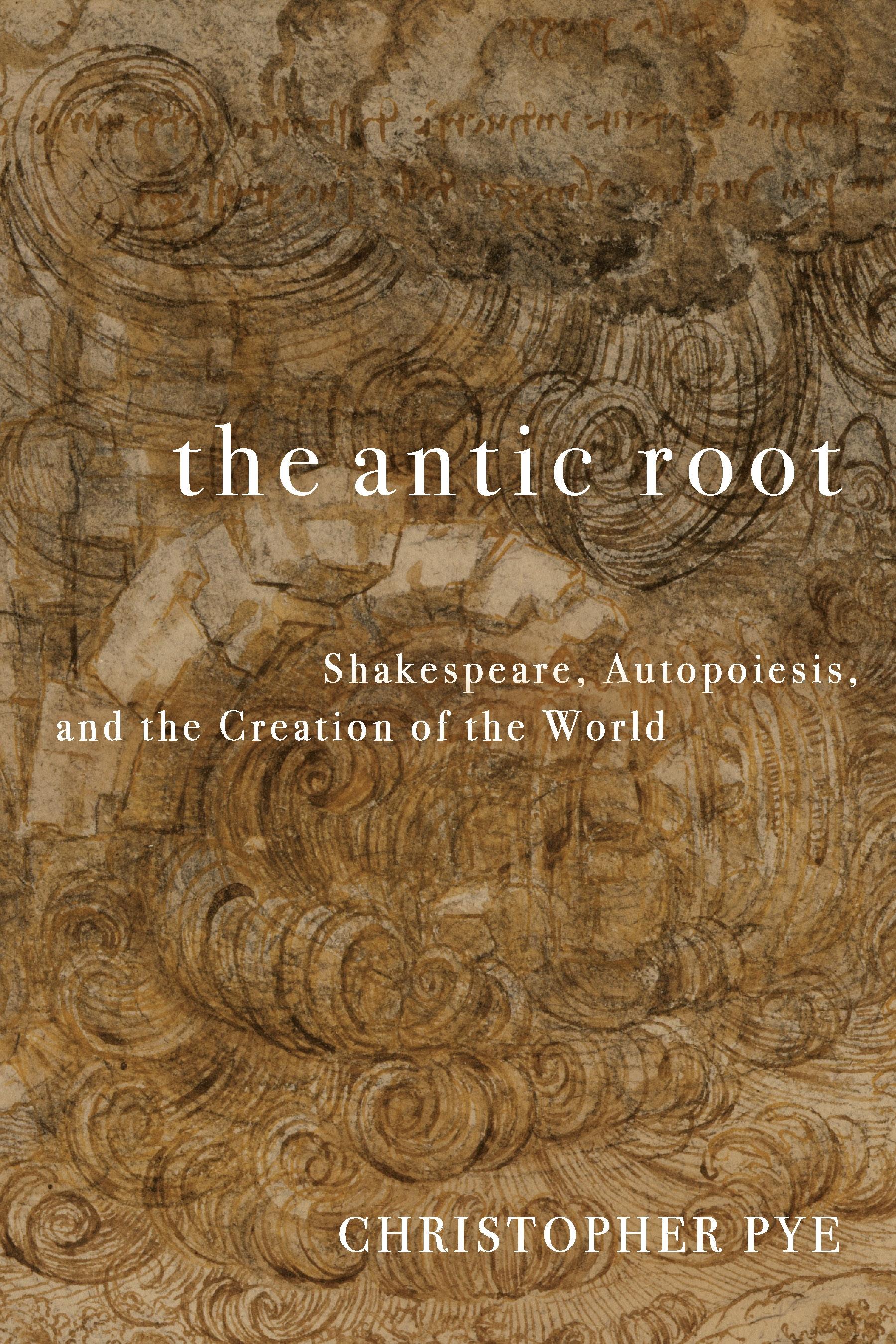
The Antic Root explores the relations among art, sense-experience, and the conception of the world in the early modern era. Against vitalist and posthumanist accounts that presume to grasp the world beyond its interpretive framing, Pye argues that any possibility of conceiving a world beyond us depends on acknowledging the fact of its mediated condition, a condition Shakespeare explored with particular acuity.
Rather than either a subjective or objective phenomenon, Pye shows how the world should be understood as an autopoietic one, that is, as a function of the process through which the very distinction between self and environment is constituted, a formative mechanism extending from the creation of the world as a phenomenal domain to the most intimate dimensions of affective life.
Coinciding with the separation of spheres during the era, autopoiesis lies at the heart of Shakespeare’s reflexive art, revealing the grounds of the works’ generic distinctions. Engaging plays from Twelfth Night to King Lear to the late romances, and concluding with an in-depth consideration of the painter Diego Velázquez, The Antic Root enlists autopoiesis to rethink the boundaries of the human in relation to affect, disability, animality, environment, and law.
Ultimately, autopoietics lets us imagine community, human and otherwise, beyond economic notions of equivalency, and justice beyond the assignation of guilt and innocence, as a condition of indebtedness that amounts to the origin of being as such.
Pay easily by card, Klarna, Apple Pay or Google Pay. Not happy? You always have a 14-day money-back guarantee. Read more in our terms. If you have any questions, email us at hello@memmo.org.
Memmo makes studying easier – wherever you are in the world. We bring your course books and smart study tools together in one place: summaries, quizzes, podcasts and flashcards. Plus Ted, your study buddy who answers anything you wonder. Over 50,000 students already study here – built to help you learn faster and stress less.