
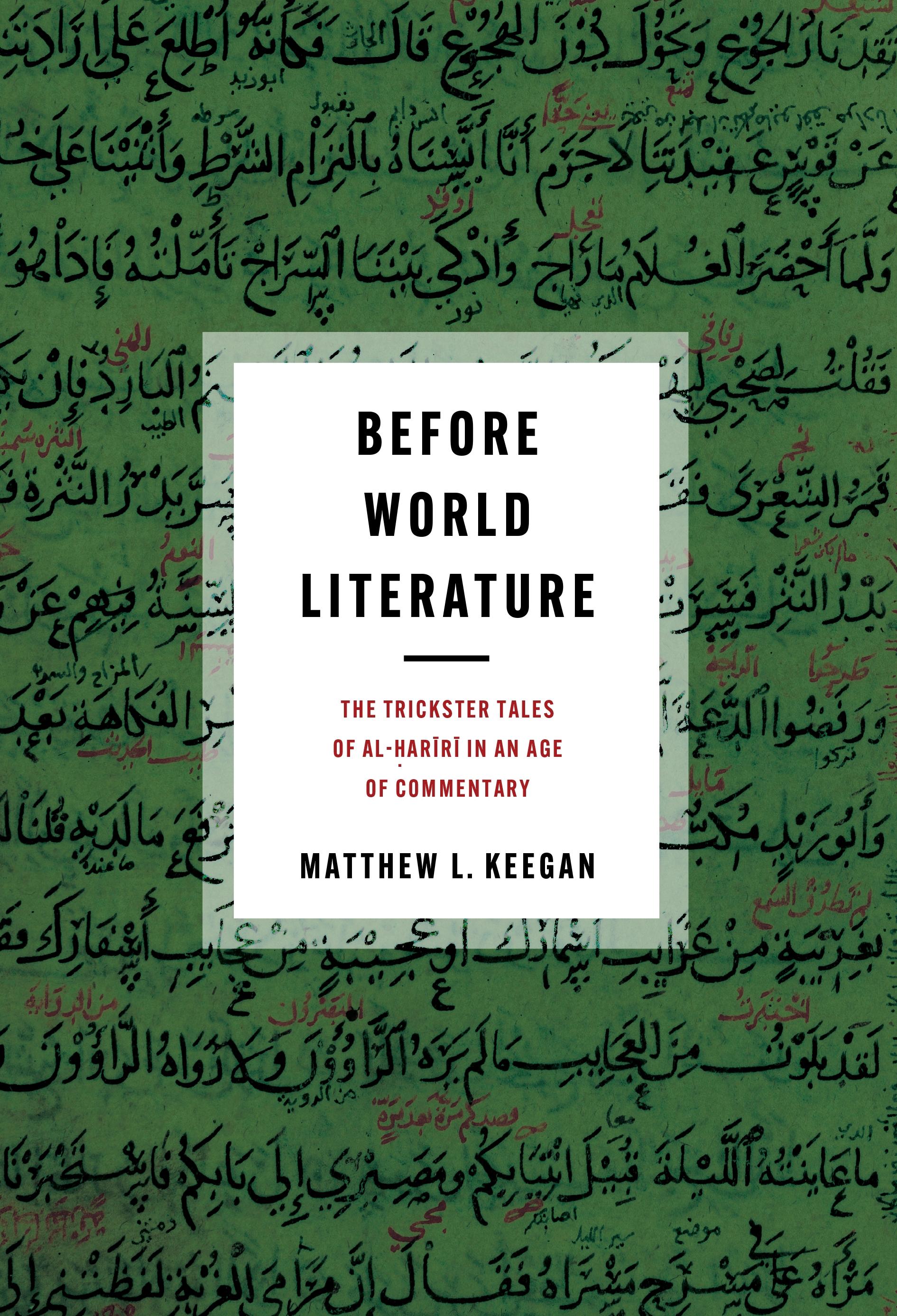
An account of Arabic literary history through the lens of the reception of the Maqāmāt of al-Ḥarīrī, a twelfth-century collection of fifty trickster stories
Before World Literature offers an account of Arabic literary history through the lens of the reception of one of the most widely read Arabic texts of the postclassical period: the Maqāmāt of al-Ḥarīrī, a twelfth-century collection of fifty trickster stories written in an elaborate and highly allusive form of prose. Innumerable Muslim scholars taught the text to new generations of students and wrote extensive commentaries on it. In the nineteenth century, however, the Maqāmāt fell rapidly out of favor, its elaborate style and its commentary tradition suddenly seen as symptoms of cultural decay.
Matthew L. Keegan shows how the emergence of world literature as a literary critical paradigm led to a wholesale reformulation of literary tastes that sidelined elaborately referential texts like the Maqāmāt. Nineteenth-century European Orientalists and Arab reformist thinkers derided the Maqāmāt for being decadent and derivative, while assailing the entire postclassical Arabic intellectual tradition. The canon of Arabic poetry and prose was reshaped accordingly, favoring classical authors whose work was perceived to be more in line with modern, European literary aesthetics.
Keegan looks to the flourishing commentary culture of the postclassical period to uncover the theories of reading and interpretation that informed engagement with Islamic texts in their own time. Tracing the social, material, and intellectual practices embedded in the commentaries on the Maqāmāt, he explores how generations of Muslims read and interpreted al-Ḥarīrī’s trickster stories, for edification and entertainment. Restoring the Maqāmāt to its place as the pinnacle of Arabic style and as an essential text of Islamic education for centuries, Before World Literature offers a model of how to read texts like the Maqāmāt on their own terms.
Pay easily by card, Klarna, Apple Pay or Google Pay. Not happy? You always have a 14-day money-back guarantee. Read more in our terms. If you have any questions, email us at hello@memmo.org.
Memmo makes studying easier – wherever you are in the world. We bring your course books and smart study tools together in one place: summaries, quizzes, podcasts and flashcards. Plus Ted, your study buddy who answers anything you wonder. Over 50,000 students already study here – built to help you learn faster and stress less.