
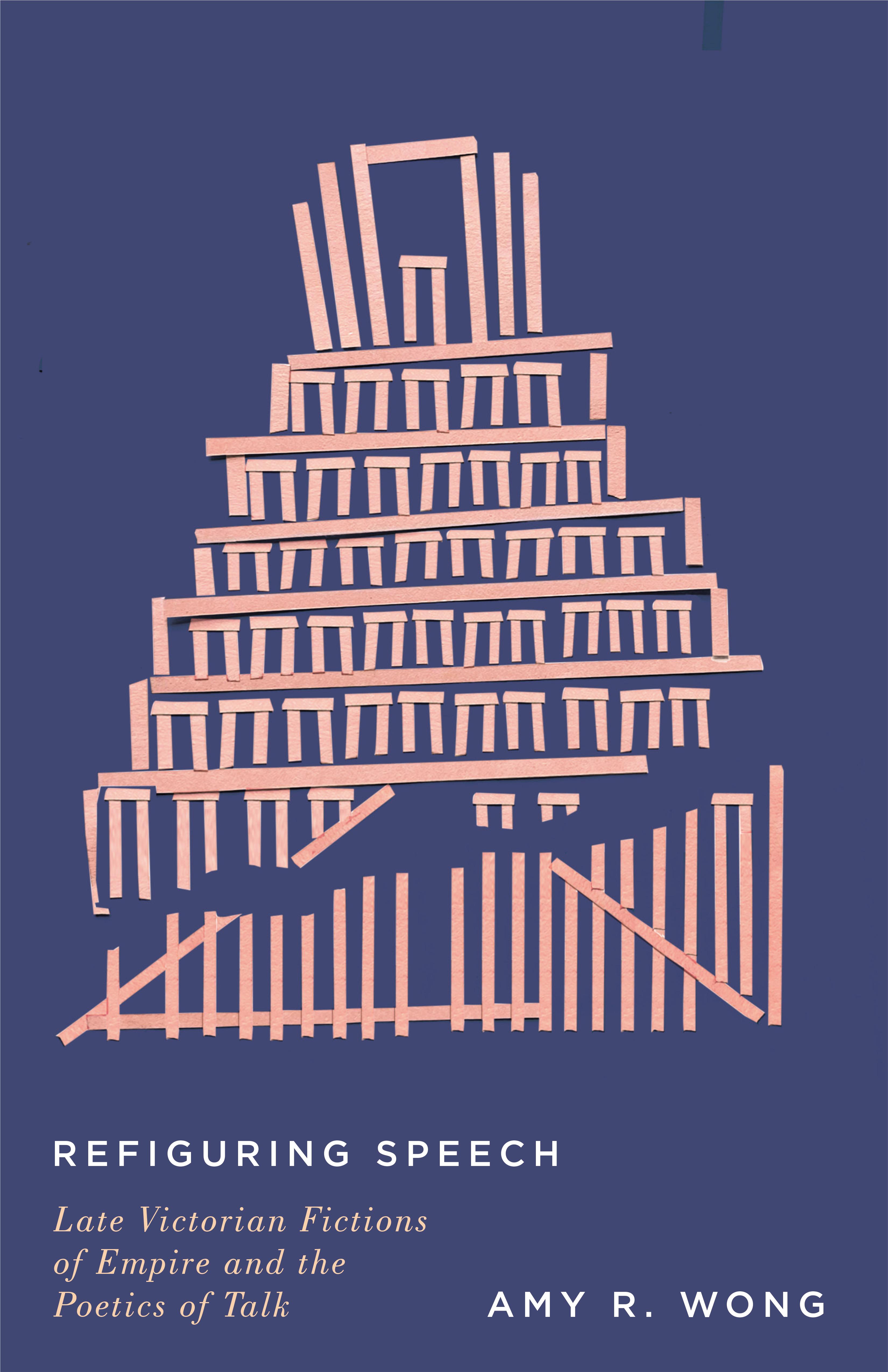
In this book, Amy R. Wong unravels the colonial and racial logic behind seemingly innocuous assumptions about "speech": that our words belong to us, and that self-possession is a virtue. Through readings of late-Victorian fictions of empire, Wong revisits the scene of speech's ideological foreclosures as articulated in postcolonial theory. Engaging Afro-Caribbean thinkers like Édouard Glissant and Sylvia Wynter, Refiguring Speech reroutes attention away from speech and toward an anticolonial poetics of talk, which emphasizes communal ownership and embeddedness within the social world and material environment.
Analyzing novels by Robert Louis Stevenson, Bram Stoker, George Meredith, Joseph Conrad, and Ford Madox Ford, Wong refashions the aesthetics of disordered speech—such as parroting, eavesdropping, profuse inarticulacy, and dysfluency—into alternate forms of communication that stand on their own as talk. Wong demonstrates how late nineteenth-century Britain's twin crises of territorialization—of empire and of new media—spurred narrative interests in capturing the sense that speech's tethering to particular persons was no longer tenable. In doing so, Wong connects this period to US empire by constructing a genealogy of Anglo-American speech's colonialist and racialized terms of proprietorship. Refiguring Speech offers students and scholars of Victorian literature and postcolonial studies a powerful conceptualization of talk as an insurgent form of communication.
Pay easily by card, Klarna, Apple Pay or Google Pay. Not happy? You always have a 14-day money-back guarantee. Read more in our terms. If you have any questions, email us at hello@memmo.org.
Memmo makes studying easier – wherever you are in the world. We bring your course books and smart study tools together in one place: summaries, quizzes, podcasts and flashcards. Plus Ted, your study buddy who answers anything you wonder. Over 50,000 students already study here – built to help you learn faster and stress less.