
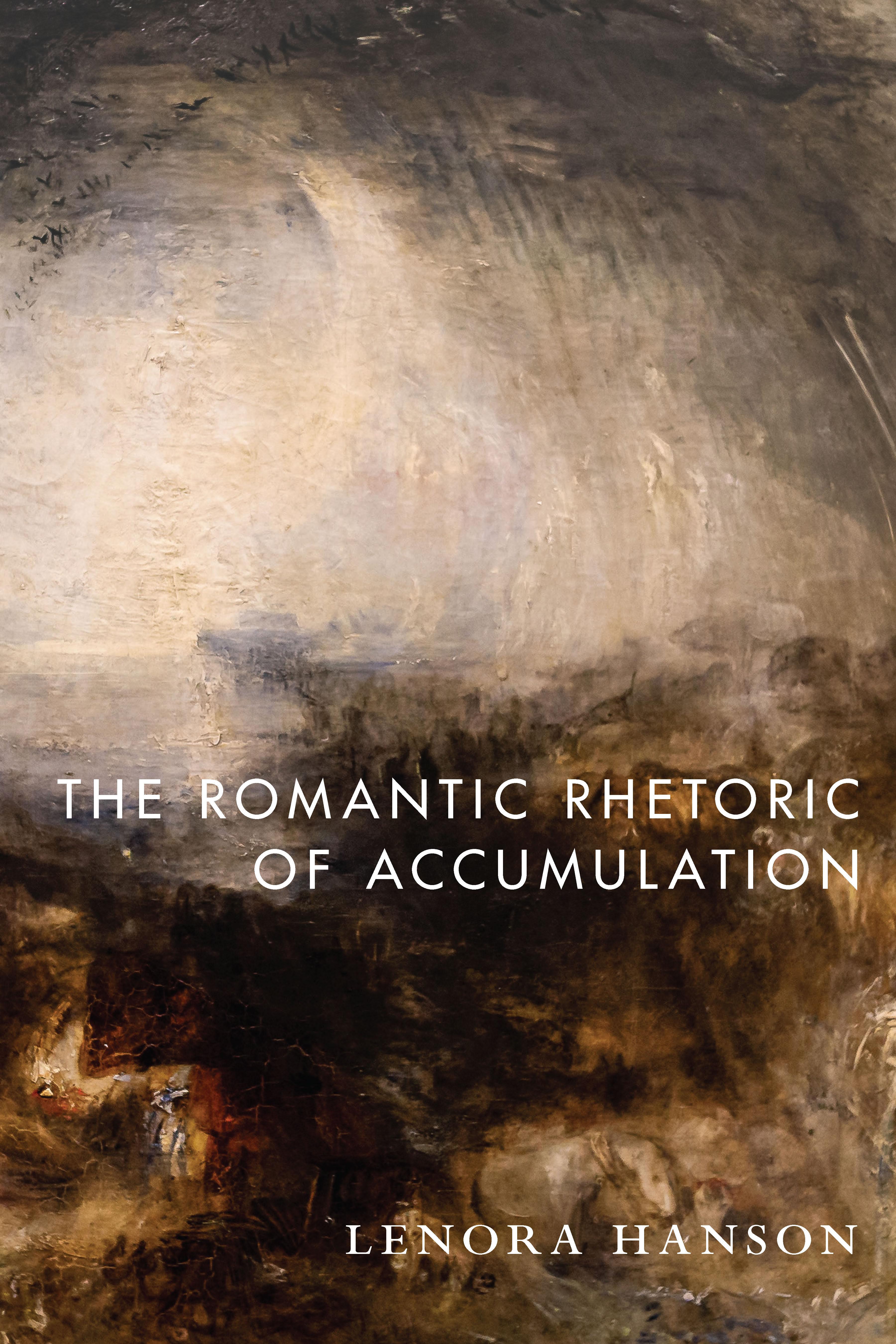
The Romantic Rhetoric of Accumulation provides an account of the long arc of dispossession from the British Romantic period to today. Lenora Hanson glimpses histories of subsistence (such as reproductive labor, vagrancy and criminality, and unwaged labor) as figural ways of living that are superfluous—simultaneously more than enough to live and less than what is necessary for capitalism.
Hanson treats rhetorical language as an archive of capital's accumulation through dispossession, in works by S.T. Coleridge, Edmund Burke, Mary Robinson, William Wordsworth, Benjamin Moseley, Joseph Priestley, and Alexander von Humboldt, as well as in contemporary film and critical theory. Reading riots through apostrophe, enclosure through anachronism, superstition and witchcraft through tautology, and the paradoxical coincidence of subsistence living with industrialization, Hanson shows the figural to be a material record of the survival of non-capitalist forms of life within capitalism. But this survival is not always-already resistant to capitalism, nor are the origins of capital accumulation confined to the Romantic past. Hanson reveals rhetorical figure as entwined in deeply ambivalent ways with the circuitous, ongoing process of dispossession.
Reading both historically and rhetorically, Hanson argues that rhetorical language records histories of dispossession and the racialized, gendered distribution of the labor of subsistence. Romanticism, they show, is more contemporary than ever.
Pay easily by card, Klarna, Apple Pay or Google Pay. Not happy? You always have a 14-day money-back guarantee. Read more in our terms. If you have any questions, email us at hello@memmo.org.
Memmo makes studying easier – wherever you are in the world. We bring your course books and smart study tools together in one place: summaries, quizzes, podcasts and flashcards. Plus Ted, your study buddy who answers anything you wonder. Over 50,000 students already study here – built to help you learn faster and stress less.