
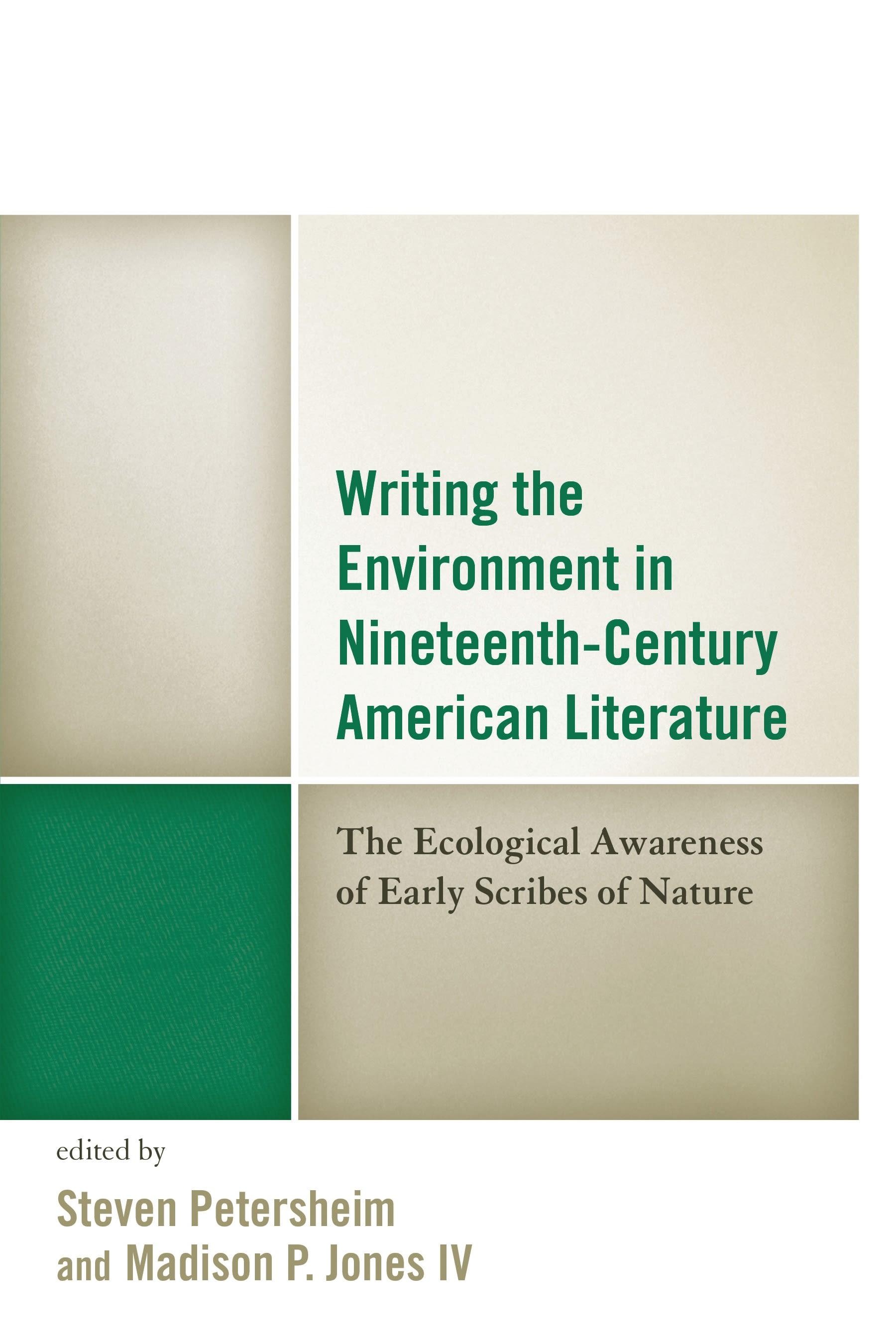
Writing the Environment in Nineteenth-Century American Literature
Author: Christoph Irmscher, Jeffrey Bilbro, Benjamin Darrell Crawford, Carrie Duke, Scott Honeycutt, Li-Ru Lu, Cecily Parks, Stephanie Peebles Tavera, Christopher Sloman, Steven Petersheim, Madison Jones IV
Publisher: Bloomsbury Publishing
Edition: 1
Published date: 2015
ISBN: 9781498508377
The nineteenth-century roots of environmental writing in American literature are often mentioned in passing and sometimes studied piece by piece. Writing the Environment in Nineteenth-Century American Literature: The Ecological Awareness of Early Scribes of Nature brings together numerous explorations of environmentally-aware writing across the genres of nineteenth-century literature. Like Lawrence Buell, the authors of this collection find Thoreau’s writing a touchstone of nineteenth-century environmental writing, particularly focusing on Thoreau’s claim that humans may function as “scribes of nature.” However, these studies of Thoreau’s antecedents, contemporaries, and successors also reveal a range of other writers in the nineteenth century whose literary treatments of nature are often more environmentally attuned than most readers have noticed.
The writers whose works are studied in this collection include canonical and forgotten writers, men and women, early nineteenth-century and late nineteenth-century authors, pioneers and conservationists. They drew attention to the conflicted relationships between humans and the American continent, as experienced by Native Americans and European Americans. Taken together, these essays offer a fresh perspective on the roots of environmental literature in nineteenth-century American nonfiction, fiction, and poetry as well as in multi-genre compositions such as the travel writings of Margaret Fuller. Bringing largely forgotten voices such as John Godman alongside canonical voices such as Nathaniel Hawthorne, Herman Melville, Walt Whitman, and Emily Dickinson, the authors whose writings are studied in this collection produced a diverse tapestry of nascent American environmental writing in the nineteenth-century. From early nineteenth-century writers such as poet Philip Freneau and novelist Charles Brockden Brown to later nineteenth-century conservationists such as John James Audubon and John Muir, Scribes of Nature shows the development of an environmental consciousness and a growing conservationist ethos in American literature.
Given their often surprisingly healthy respect for the natural environment, these nineteenth-century writers offer us much to consider in an age of environmental crisis. The complexities of the supposed nature/culture divide still work into our lives today as economic and environmental issues are often seen at loggerheads when they ought to be seen as part of the same conversation of what it means to live healthy lives, and to pass on a healthy world to those who follow us in a world where human activity is becoming increasingly threatening to the health of our planet.
The writers whose works are studied in this collection include canonical and forgotten writers, men and women, early nineteenth-century and late nineteenth-century authors, pioneers and conservationists. They drew attention to the conflicted relationships between humans and the American continent, as experienced by Native Americans and European Americans. Taken together, these essays offer a fresh perspective on the roots of environmental literature in nineteenth-century American nonfiction, fiction, and poetry as well as in multi-genre compositions such as the travel writings of Margaret Fuller. Bringing largely forgotten voices such as John Godman alongside canonical voices such as Nathaniel Hawthorne, Herman Melville, Walt Whitman, and Emily Dickinson, the authors whose writings are studied in this collection produced a diverse tapestry of nascent American environmental writing in the nineteenth-century. From early nineteenth-century writers such as poet Philip Freneau and novelist Charles Brockden Brown to later nineteenth-century conservationists such as John James Audubon and John Muir, Scribes of Nature shows the development of an environmental consciousness and a growing conservationist ethos in American literature.
Given their often surprisingly healthy respect for the natural environment, these nineteenth-century writers offer us much to consider in an age of environmental crisis. The complexities of the supposed nature/culture divide still work into our lives today as economic and environmental issues are often seen at loggerheads when they ought to be seen as part of the same conversation of what it means to live healthy lives, and to pass on a healthy world to those who follow us in a world where human activity is becoming increasingly threatening to the health of our planet.
Pages: 254
Category: Litteraturvetenskap & Teori
e-ISBN: 9781498508384
Shipping weight: 1.2 kg
Ships in: 1-2 days
Pay easily by card, Klarna, Apple Pay or Google Pay. Not happy? You always have a 14-day money-back guarantee. Read more in our terms. If you have any questions, email us at hello@memmo.org.
Memmo makes studying easier – wherever you are in the world. We bring your course books and smart study tools together in one place: summaries, quizzes, podcasts and flashcards. Plus Ted, your study buddy who answers anything you wonder. Over 50,000 students already study here – built to help you learn faster and stress less.