
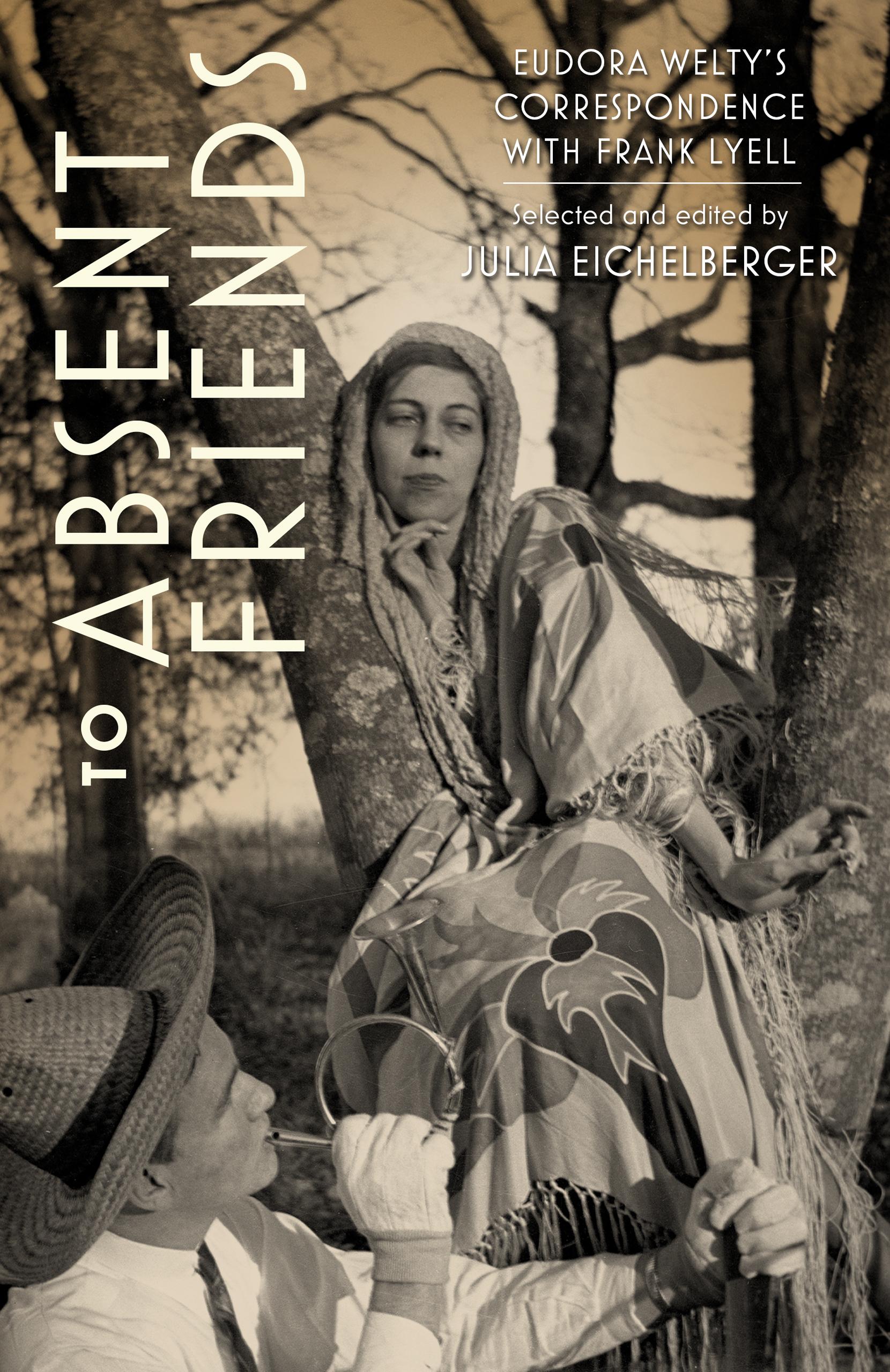
With over 350 complete or excerpted letters, most previously unpublished, To Absent Friends: Eudora Welty's Correspondence with Frank Lyell forms an epistolary narrative of Welty’s writing life and her nearly fifty-year friendship with Frank Lyell, a friend from Jackson, Mississippi. Also included in the text are extensive annotations to explain the letters’ myriad, often telegraphic cultural references. Early letters show both correspondents’ youthful exuberance as Lyell pursued graduate studies at Princeton and Welty, based in Jackson, visited New York whenever she could. They saw much to ridicule in the grown-up world they were entering, but their letters also convey deep admiration for music, literature, art, dance, and other cultural expressions.
Letters from the 1940s discuss Welty’s work in progress, Lyell’s wartime service in the Army Air Forces Intelligence, and his teaching jobs in North Carolina and Texas. In the 1950s, her mother’s health began to fail, and the civil rights movement and other world events hovered in the background of letters reporting on the Weltys’ challenging lives. As Welty’s fame grew, the friends continued to share gossip, descriptions of enjoyably bad movies, and reports on literature that moved them.
The friends’ final decade of correspondence includes playfulness alongside poignant reminders of their own aging. Becoming quieter, calmer versions of their youthful selves, they retained their delight in high and low culture, their veneration of art, and their love of the absurd. Taken together, these letters document a remarkable artist’s responses to her time and place and a sparkling friendship.
Letters from the 1940s discuss Welty’s work in progress, Lyell’s wartime service in the Army Air Forces Intelligence, and his teaching jobs in North Carolina and Texas. In the 1950s, her mother’s health began to fail, and the civil rights movement and other world events hovered in the background of letters reporting on the Weltys’ challenging lives. As Welty’s fame grew, the friends continued to share gossip, descriptions of enjoyably bad movies, and reports on literature that moved them.
The friends’ final decade of correspondence includes playfulness alongside poignant reminders of their own aging. Becoming quieter, calmer versions of their youthful selves, they retained their delight in high and low culture, their veneration of art, and their love of the absurd. Taken together, these letters document a remarkable artist’s responses to her time and place and a sparkling friendship.
Pay easily by card, Klarna, Apple Pay or Google Pay. Not happy? You always have a 14-day money-back guarantee. Read more in our terms. If you have any questions, email us at hello@memmo.org.
Memmo makes studying easier – wherever you are in the world. We bring your course books and smart study tools together in one place: summaries, quizzes, podcasts and flashcards. Plus Ted, your study buddy who answers anything you wonder. Over 50,000 students already study here – built to help you learn faster and stress less.
You might also like
Buy the book0