
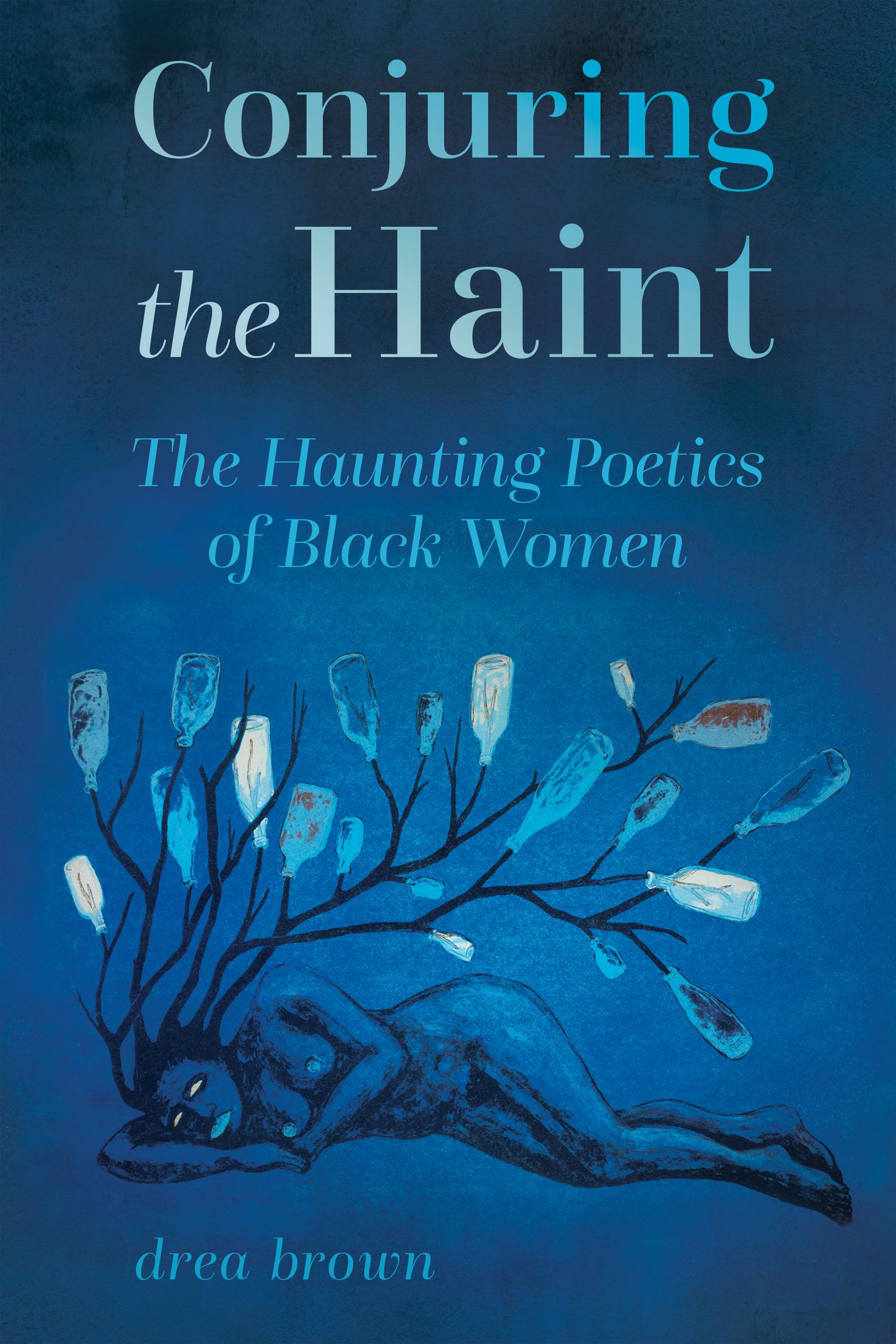
What does it mean to live as a ghost, to live with ghosts, and how might ghosts lead to a path of healing and reimagining? Through an investigation of the intimate relationship between haunting and grief, Conjuring the Haint: The Haunting Poetics of Black Women posits that for Black women, haunting is both a condition and a strategy in lived experiences and literary productions.
Looking at the poetry of Phillis Wheatley, Lucille Clifton, Ntozake Shange, Lyrae Van Clief-Stefanon, and Claudia Rankine, Conjuring the Haint explores primary stereotypes of Black women. They are aligned with unruly incarnations of the haint, probing the eerie similarities between this specter and one-dimensional imaginings of Black womanhood, examining how this haintliness manifests in Black women’s elegies, the poetry of grief. Disrupting a tradition of consolation and poetic succession, Black women’s elegies rework the genre by wrestling with multiple forms of death: physical, social, and spiritual. These elegies aim both to lay to rest and to resurrect. Black women poets are then repositioned as conjurers who, through the spirit work of poetry, reckon with haints as complex figures of despair and repair.
Each chapter explores the paradox of haints, as evidence of injury and loss and as a pathway to knowledge articulated by various incarnations—the hag, the banshee, and the vengeful revenant. Chapters place these against pervasive images of Mammy, Jezebel, and Sapphire. Through a pairing and dismantling of these ill-fitting myths, Conjuring the Haint refigures haints as a means of recognition and self-possession, a manifestation of the ancestral and divine.
Looking at the poetry of Phillis Wheatley, Lucille Clifton, Ntozake Shange, Lyrae Van Clief-Stefanon, and Claudia Rankine, Conjuring the Haint explores primary stereotypes of Black women. They are aligned with unruly incarnations of the haint, probing the eerie similarities between this specter and one-dimensional imaginings of Black womanhood, examining how this haintliness manifests in Black women’s elegies, the poetry of grief. Disrupting a tradition of consolation and poetic succession, Black women’s elegies rework the genre by wrestling with multiple forms of death: physical, social, and spiritual. These elegies aim both to lay to rest and to resurrect. Black women poets are then repositioned as conjurers who, through the spirit work of poetry, reckon with haints as complex figures of despair and repair.
Each chapter explores the paradox of haints, as evidence of injury and loss and as a pathway to knowledge articulated by various incarnations—the hag, the banshee, and the vengeful revenant. Chapters place these against pervasive images of Mammy, Jezebel, and Sapphire. Through a pairing and dismantling of these ill-fitting myths, Conjuring the Haint refigures haints as a means of recognition and self-possession, a manifestation of the ancestral and divine.
Pay easily by card, Klarna, Apple Pay or Google Pay. Not happy? You always have a 14-day money-back guarantee. Read more in our terms. If you have any questions, email us at hello@memmo.org.
Memmo makes studying easier – wherever you are in the world. We bring your course books and smart study tools together in one place: summaries, quizzes, podcasts and flashcards. Plus Ted, your study buddy who answers anything you wonder. Over 50,000 students already study here – built to help you learn faster and stress less.
You might also like
Buy the book0