
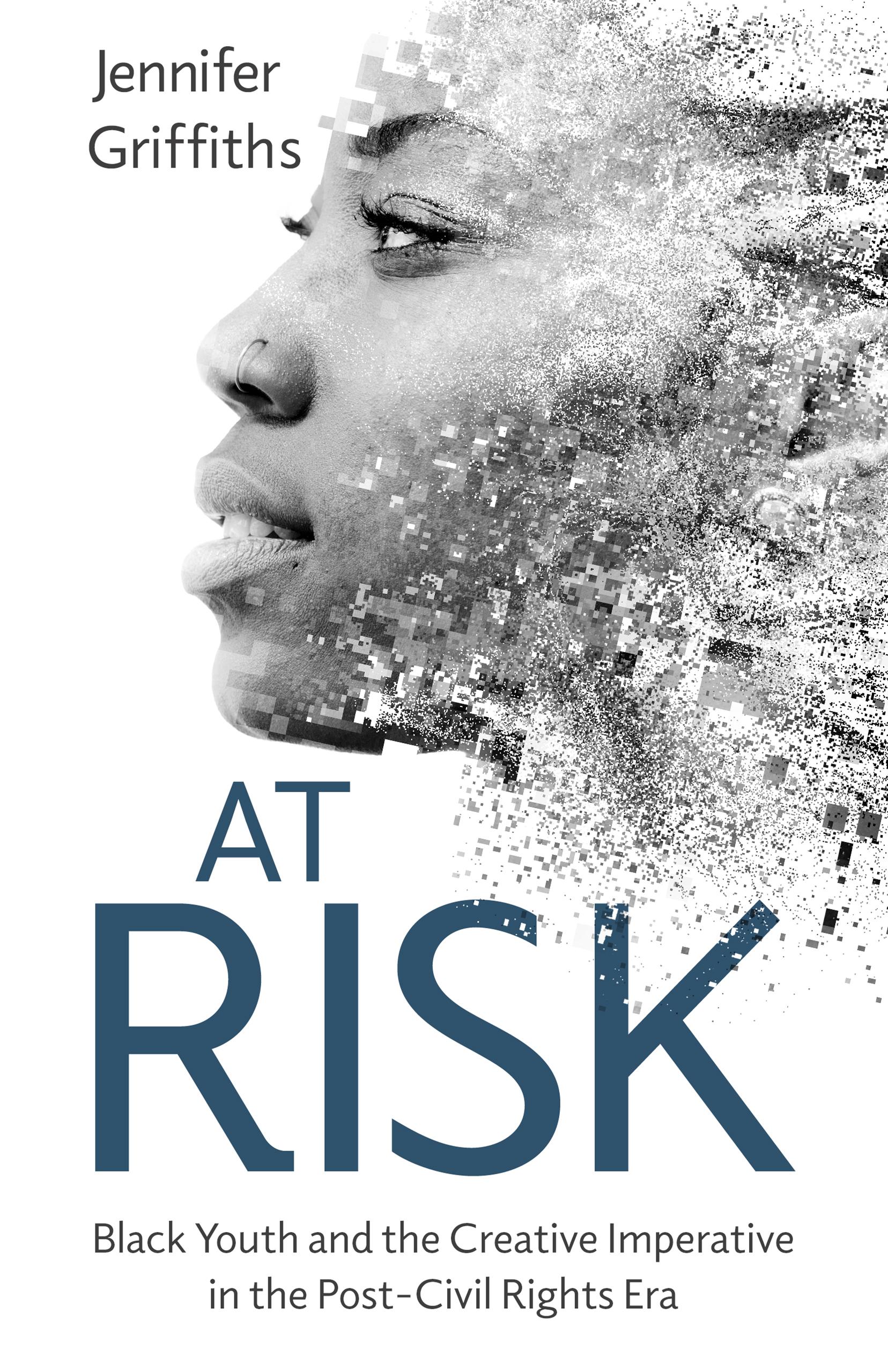
Jennifer Griffiths's At Risk: Black Youth and the Creative Imperative in the Post–Civil Rights Era focuses on literary representations of adolescent artists as they develop strategies to intervene against the stereotypes that threaten to limit their horizons. The authors of the analyzed works capture and convey the complex experience of the generation of young people growing up in the era after the civil rights movement. Through creative experiments, they carefully consider what it means to be narrowed within the scope of a sociological “problem,” all while trying to expand the perspective of creative liberation. In short, they explore what it means to be deemed an “at risk” youth.
This book looks at crucial works beginning in 1968, ranging from Sapphire’s Push and The Kid, Walter Dean Myers’s Monster, and Dael Orlandersmith’s The Gimmick, to Bill Gunn’s Johnnas. Each text offers unique representations of Black gifted children, whose creative processes help them to navigate simultaneous hypervisibility and invisibility as racialized subjects. The book addresses the ways that adolescents experience the perilous “at risk” label, which threatens to narrow adolescent existence at a developmental moment that requires an orientation toward possibility and a freedom to experiment.
Ultimately, At Risk considers the distinct possibilities and challenges of the post–civil rights era, and how the period allows for a more honest, multilayered, and forthright depiction of Black youth subjectivity against the adultification that forecloses potential.
This book looks at crucial works beginning in 1968, ranging from Sapphire’s Push and The Kid, Walter Dean Myers’s Monster, and Dael Orlandersmith’s The Gimmick, to Bill Gunn’s Johnnas. Each text offers unique representations of Black gifted children, whose creative processes help them to navigate simultaneous hypervisibility and invisibility as racialized subjects. The book addresses the ways that adolescents experience the perilous “at risk” label, which threatens to narrow adolescent existence at a developmental moment that requires an orientation toward possibility and a freedom to experiment.
Ultimately, At Risk considers the distinct possibilities and challenges of the post–civil rights era, and how the period allows for a more honest, multilayered, and forthright depiction of Black youth subjectivity against the adultification that forecloses potential.
Pay easily by card, Klarna, Apple Pay or Google Pay. Not happy? You always have a 14-day money-back guarantee. Read more in our terms. If you have any questions, email us at hello@memmo.org.
Memmo makes studying easier – wherever you are in the world. We bring your course books and smart study tools together in one place: summaries, quizzes, podcasts and flashcards. Plus Ted, your study buddy who answers anything you wonder. Over 50,000 students already study here – built to help you learn faster and stress less.
You might also like
Buy the book0