
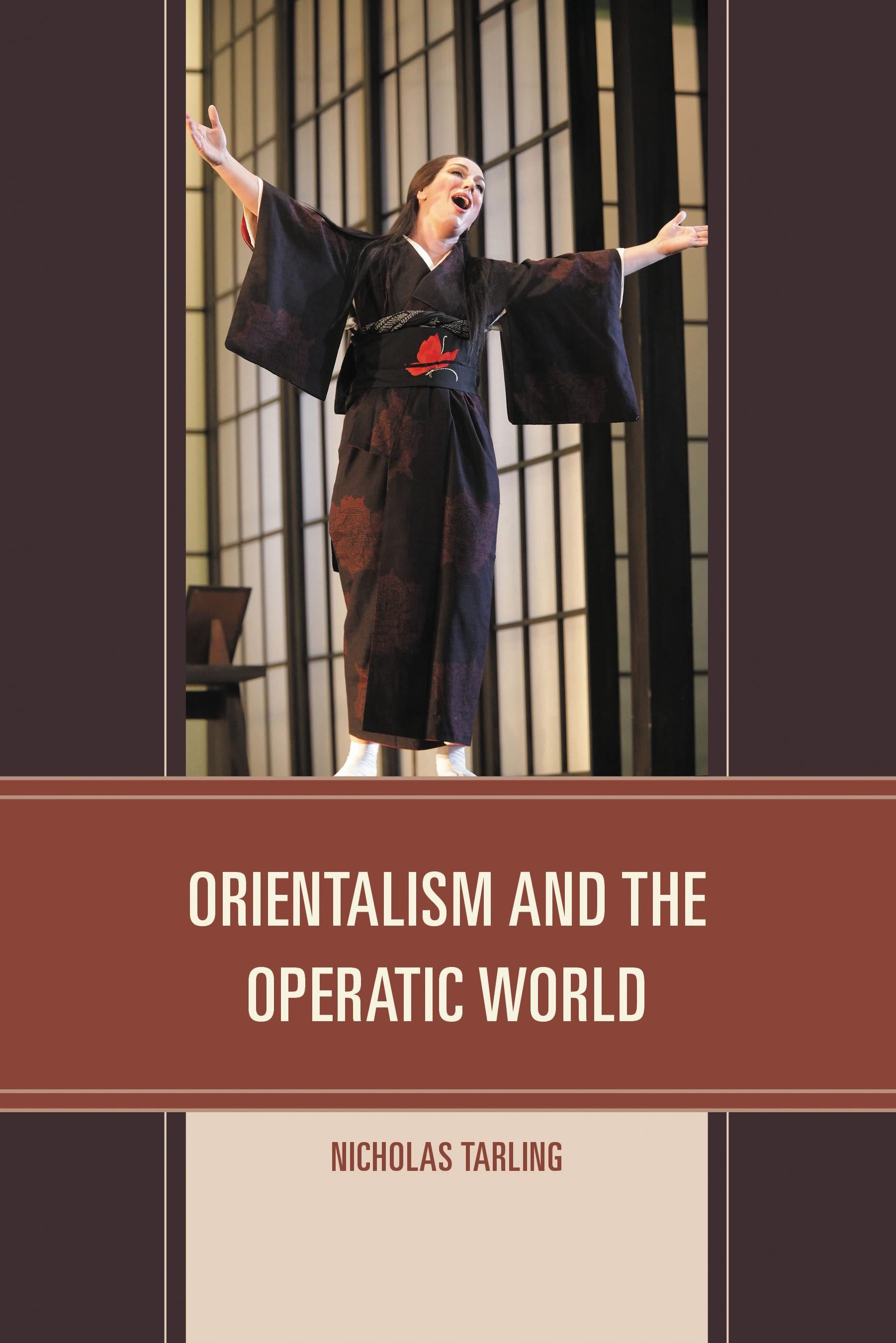
Western opera is a globalized and globalizing phenomenon and affords us a unique opportunity for exploring the concept of “orientalism,” the subject of literary scholar Edward Said’s modern classic on the topic. Nicholas Tarling’s Orientalism and the Operatic World places opera in the context of its steady globalization over the past two centuries. In this important survey, Tarling first considers how the Orient appears on the operatic stage in Britain, France, Germany, Russia, and the United States before exploring individual operas according to the region of the “Orient” in which the work is set.
Throughout, Tarling offers key insights into such notable operas as George Frideric Handel’s Berenice, Giuseppe Verdi’s Aida, Giacomo Puccini’s MadamaButterfly, Pietro Mascagni’s Iris, and others. Orientalism and the Operatic World argues that any close study of the history of Western opera, in the end, fails to support the notion propounded by Said that Westerners inevitably stereotyped, dehumanized, and ultimately sought only to dominate the East through art. Instead, Tarling argues that opera is a humanizing art, one that emphasizes what humanity has in common by epic depictions of passion through the vehicle of song.
Orientalism and the Operatic World is not merely for opera buffs or even first-time listeners. It should also interest historians of both the East and West, scholars of international relations, and cultural theorists.
Throughout, Tarling offers key insights into such notable operas as George Frideric Handel’s Berenice, Giuseppe Verdi’s Aida, Giacomo Puccini’s MadamaButterfly, Pietro Mascagni’s Iris, and others. Orientalism and the Operatic World argues that any close study of the history of Western opera, in the end, fails to support the notion propounded by Said that Westerners inevitably stereotyped, dehumanized, and ultimately sought only to dominate the East through art. Instead, Tarling argues that opera is a humanizing art, one that emphasizes what humanity has in common by epic depictions of passion through the vehicle of song.
Orientalism and the Operatic World is not merely for opera buffs or even first-time listeners. It should also interest historians of both the East and West, scholars of international relations, and cultural theorists.
Pages: 354
Category: Kultur-, Genus- & Postkoloniala studier
e-ISBN: 9781442245440
Shipping weight: 1.2 kg
Ships in: 1-2 days
Pay easily by card, Klarna, Apple Pay or Google Pay. Not happy? You always have a 14-day money-back guarantee. Read more in our terms. If you have any questions, email us at hello@memmo.org.
Memmo makes studying easier – wherever you are in the world. We bring your course books and smart study tools together in one place: summaries, quizzes, podcasts and flashcards. Plus Ted, your study buddy who answers anything you wonder. Over 50,000 students already study here – built to help you learn faster and stress less.