
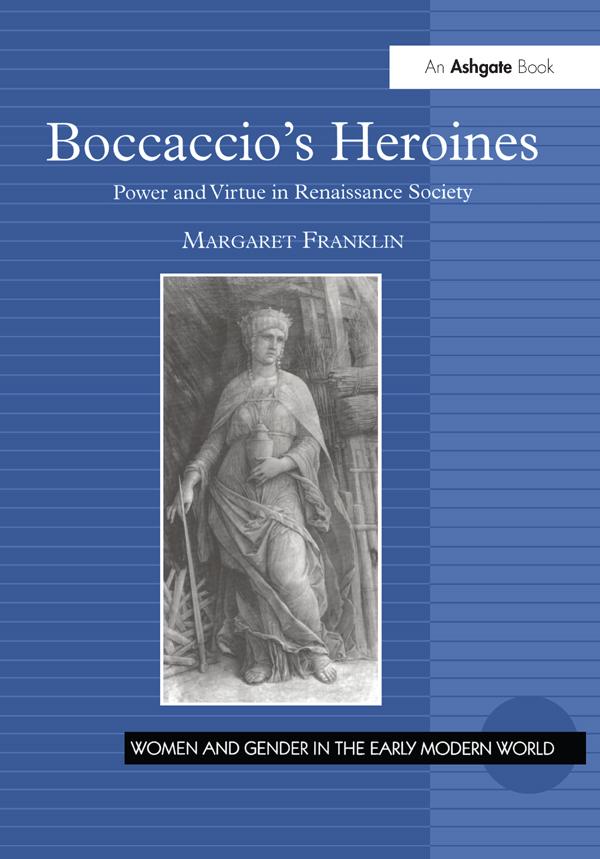
In contrast to earlier scholars who have seen Boccaccio's Famous Women as incoherent and fractured, Franklin argues that the text offers a remarkably consistent, coherent and comprehensible treatise concerning the appropriate functioning of women in society. In this cross disciplinary study of a seminal work of literature and its broader cultural impact on Renaissance society, Franklin shows that, through both literature and the visual arts, Famous Women was used to promote social ideologies in both Renaissance Tuscany and the dynastic courts of northern Italy. Speaking equally to scholars in medieval and early modern literature, history, and art history, Franklin brings needed clarification to the text by demonstrating that the moral criteria Boccaccio used to judge the lives of legendary women - heroines and miscreants alike - were employed consistently to tackle the challenge that politically powerful women represented for the prevailing social order. Further, the author brings to light the significant influence of Boccaccio's text on the representation of classical heroines in Renaissance art. By examining several paintings created in the republics and principalities of Renaissance Italy, Franklin demonstrates that Famous Women was employed as a conceptual guide by patrons and artists to draw the teeth from the challenge of unconventionally powerful women by co-opting their stories into the service of contemporary Italian standards and mores.
Pay easily by card, Klarna, Apple Pay or Google Pay. Not happy? You always have a 14-day money-back guarantee. Read more in our terms. If you have any questions, email us at hello@memmo.org.
Memmo makes studying easier – wherever you are in the world. We bring your course books and smart study tools together in one place: summaries, quizzes, podcasts and flashcards. Plus Ted, your study buddy who answers anything you wonder. Over 50,000 students already study here – built to help you learn faster and stress less.
You might also like
Buy the book0