
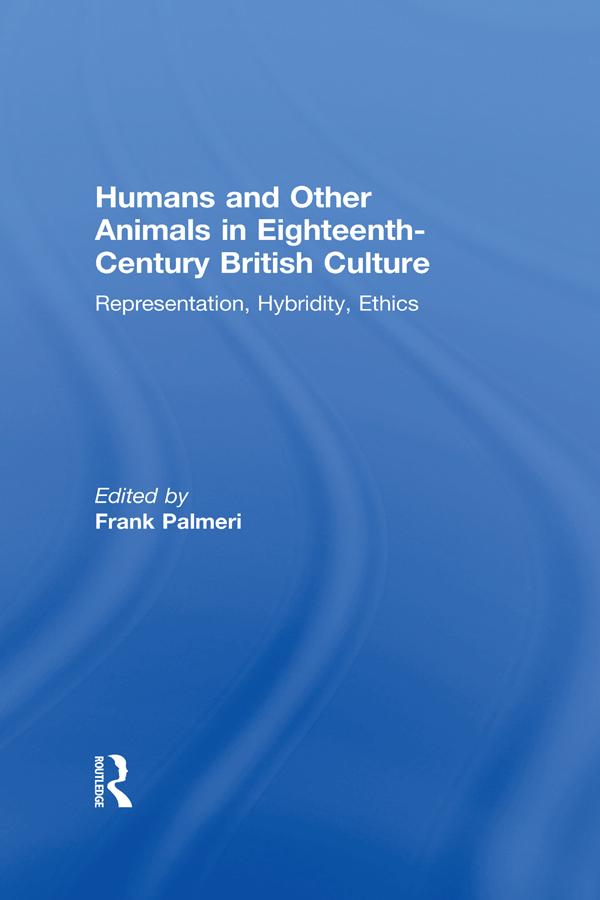
Combining historical and interpretive work, this collection examines changing perceptions of and relations between human and nonhuman animals in Britain over the long eighteenth century. Persistent questions concern modes of representing animals and animal-human hybrids, as well as the ethical issues raised by the human uses of other animals. From the animal men of Thomas Rowlandson to the part animal-part human creature of Victor Frankenstein, hybridity serves less as a metaphor than as a metonym for the intersections of humans and other animals. The contributors address such recurring questions as the implications of the Enlightenment project of naming and classifying animals, the equating of non-European races and nonhuman animals in early ethnographic texts, and the desire to distinguish the purely human from the entirely nonhuman animal. Gulliver's Travels and works by Mary and Percy Shelley emerge as key texts for this study. The volume will be of interest to scholars and students who work in animal, colonial, gender, and cultural studies; and will appeal to general readers concerned with the representation of animals and their treatment by humans.
Pay easily by card, Klarna, Apple Pay or Google Pay. Not happy? You always have a 14-day money-back guarantee. Read more in our terms. If you have any questions, email us at hello@memmo.org.
Memmo makes studying easier – wherever you are in the world. We bring your course books and smart study tools together in one place: summaries, quizzes, podcasts and flashcards. Plus Ted, your study buddy who answers anything you wonder. Over 50,000 students already study here – built to help you learn faster and stress less.
You might also like
Buy the book0