
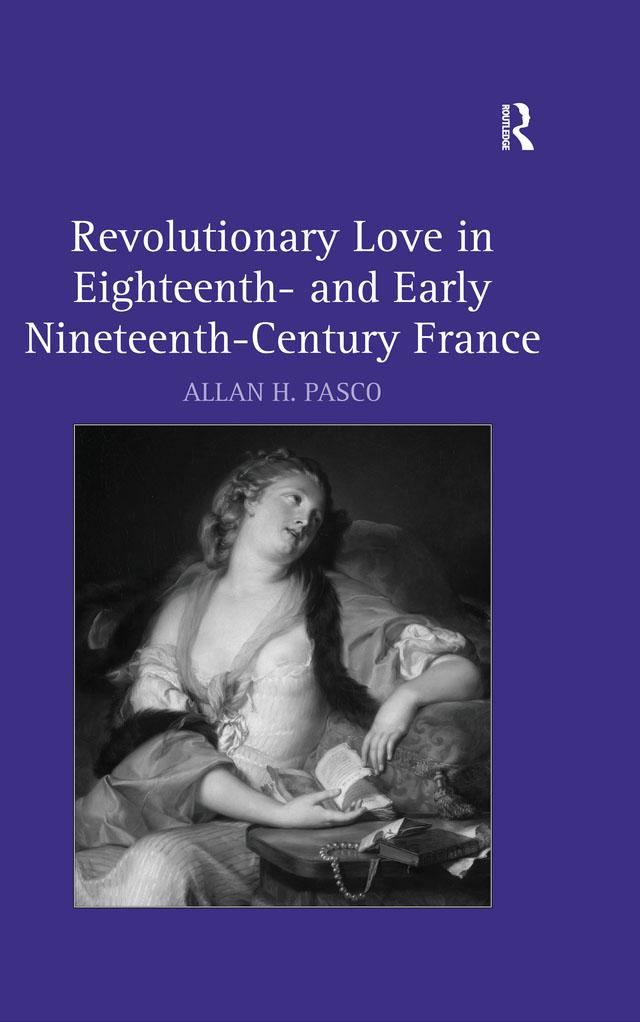
In this innovative study, the author carves out a new field, a sociology of literature in which he offers insightful commentary about the nexus of literature and society. Calling on history, sociology, and psychology as well as literature as points of reference, Allan Pasco examines the conceptual shift in the ideal of love in eighteenth-century France. Pasco explores the radical, though gradual, changes that occurred during the Enlightenment with respect to how the emotion of love was viewed. Earlier, love had been subordinate to the demands of family, king, and deity; passion was dangerous, and to be avoided. But over time, individual happiness became the "greatest good," and passion the measure of love. Authors as diverse as Marivaux, Marmontel, Rousseau, Baculard d'Arnaud, Pigault-Lebrun and Madame de Staël make it clear that the ideal of rapturous love did not live up to its billing: it did not last, and it brought destructive fantasies, an epidemic of disease, the "scourge" of divorce, and considerable anguish. Still, as Pasco points out, passion became and remained the ideal, and the Romantics were left to plumb its nature.
Pages: 236
Category: Litteraturvetenskap & Teori
e-ISBN: 9781351903288
Shipping weight: 1.2 kg
Ships in: 1-2 days
Pay easily by card, Klarna, Apple Pay or Google Pay. Not happy? You always have a 14-day money-back guarantee. Read more in our terms. If you have any questions, email us at hello@memmo.org.
Memmo makes studying easier – wherever you are in the world. We bring your course books and smart study tools together in one place: summaries, quizzes, podcasts and flashcards. Plus Ted, your study buddy who answers anything you wonder. Over 50,000 students already study here – built to help you learn faster and stress less.
You might also like
Buy the book0