
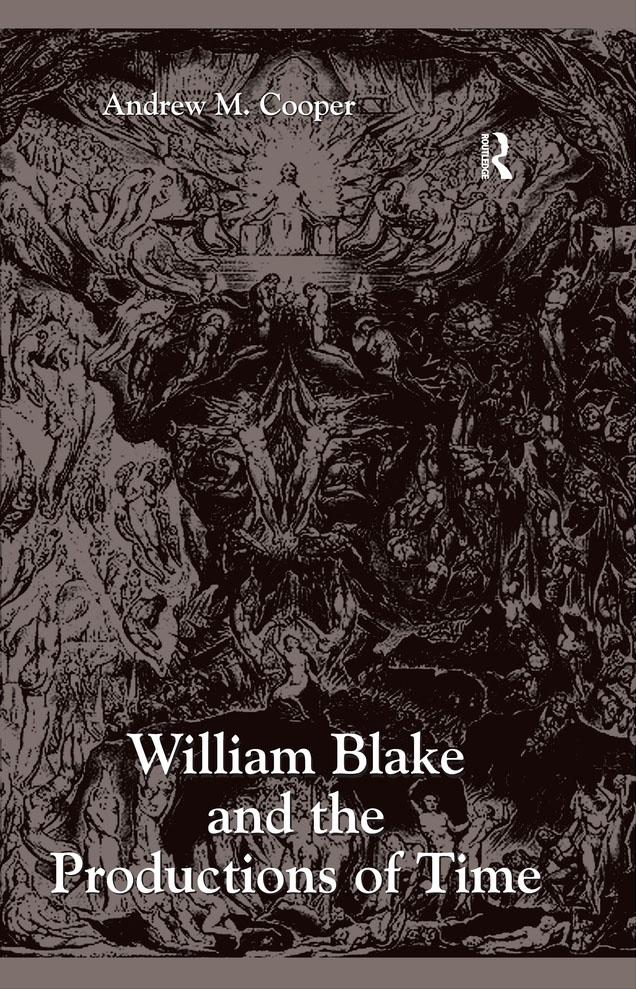
Challenging the idea that a writer’s work reflects his experiences in time and place, Andrew M. Cooper locates the action of William Blake’s major illuminated books in the ahistorical present, an impersonal spirit realm beyond the three-dimensional self. Blake, Cooper shows, was a formalist who exploited eighteenth-century scientific and philosophical research on vision, sense, and mind for spiritual purposes. Through irony, dialogism, two-way syntax, and synesthesia, Blake extended and refined the prophetic method Milton forged in Paradise Lost to bring the performativity of traditional oral song and storytelling into print. Cooper argues that historicist attempts to place Blake’s vision in perspective, as opposed to seeing it for oneself, involve a deeply self-contradictory denial of his performativity as a poet-artist. Rather, Blake’s expansion of linear reading into a space of creative, self-conscious collaboration laid the basis for his lifelong critique of dualism in religion and science, and anticipated the non-Euclidean geometrics of twentieth-century Modernism.
Pages: 362
Category: Litteraturvetenskap & Teori
e-ISBN: 9781351872928
Shipping weight: 1.2 kg
Ships in: 1-2 days
Pay easily by card, Klarna, Apple Pay or Google Pay. Not happy? You always have a 14-day money-back guarantee. Read more in our terms. If you have any questions, email us at hello@memmo.org.
Memmo makes studying easier – wherever you are in the world. We bring your course books and smart study tools together in one place: summaries, quizzes, podcasts and flashcards. Plus Ted, your study buddy who answers anything you wonder. Over 50,000 students already study here – built to help you learn faster and stress less.
You might also like
Buy the book0