
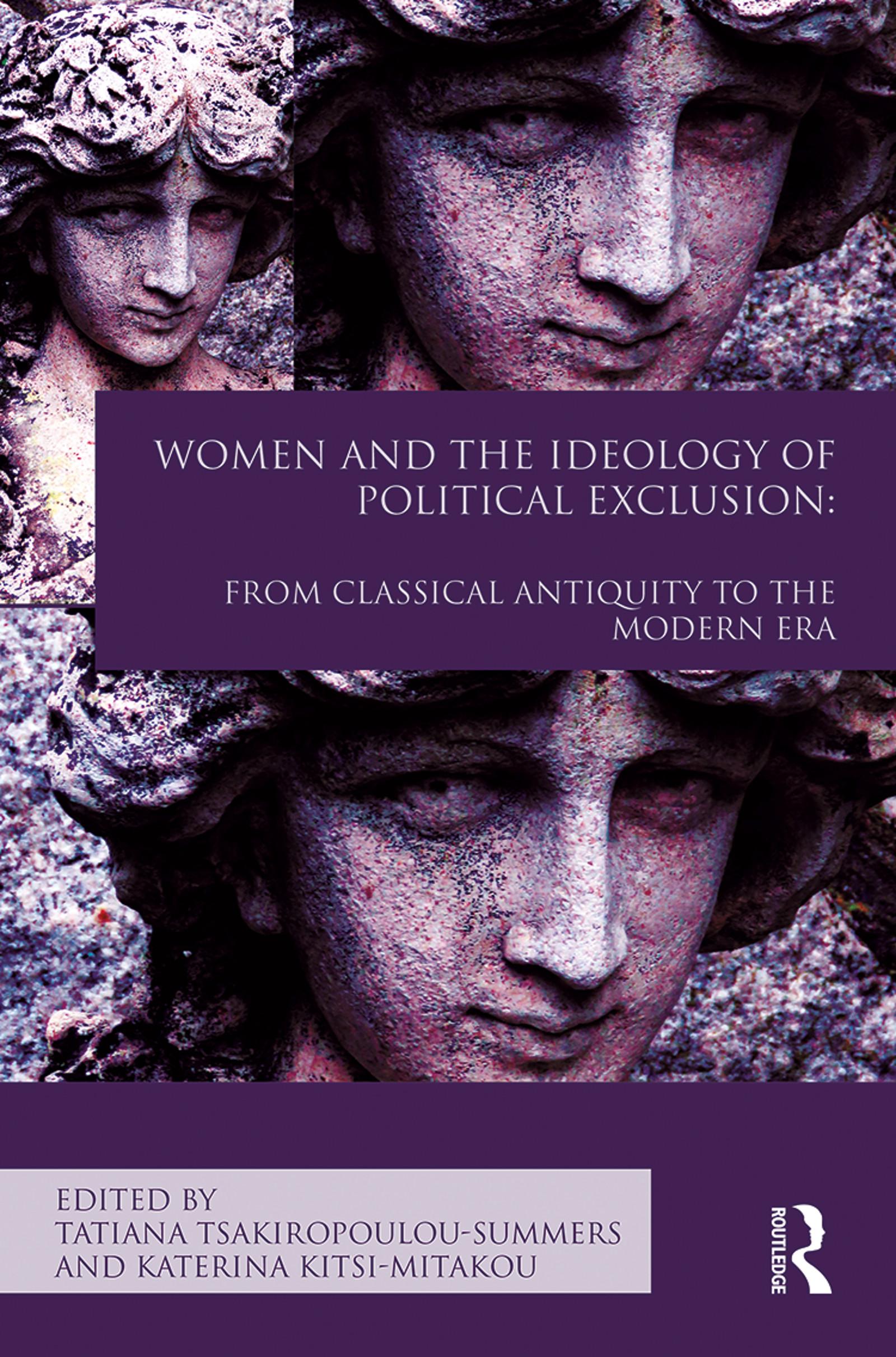
Women and the Ideology of Political Exclusion explores the origin and evolution of the political ideology that has kept women away from centers of political power – from the birth of democracy in ancient Athens to the modern era. In this period of 2500 years, two parallel tracks advanced: while male authority tried to construct an ideology that justified women’s incompatibility with the political organization of the state, women attempted to resist their exclusion and thwart arguments about their inferiority.
Although the issue of women’s status has been studied in detail in specific eras, this interdisciplinary collection extends the boundaries of the discussion. Drawing on a wide range of literary and historical sources, including Herodotus’ Histories, Plato’s Laws, María de San José’s Oaxaca Manuscript, and the work of Émilie Du Châtelet, Mary Boykin Chesnut, and Virginia Woolf, the chapters here reveal the various manifestations of the female-inferiority construct. Such an extensive overview of this historical trajectory promotes a deeper understanding of its causes, permutations, and persistence.
Women may have made great gains toward political power, but they continue to encounter invisible barriers, raised by traditional stereotypes, that block their path to success. Women and the Ideology of Political Exclusion aims to make these barriers visible, raising awareness about the longevity and tenacity of arguments, the roots of which reach classical antiquity.
Pay easily by card, Klarna, Apple Pay or Google Pay. Not happy? You always have a 14-day money-back guarantee. Read more in our terms. If you have any questions, email us at hello@memmo.org.
Memmo makes studying easier – wherever you are in the world. We bring your course books and smart study tools together in one place: summaries, quizzes, podcasts and flashcards. Plus Ted, your study buddy who answers anything you wonder. Over 50,000 students already study here – built to help you learn faster and stress less.