
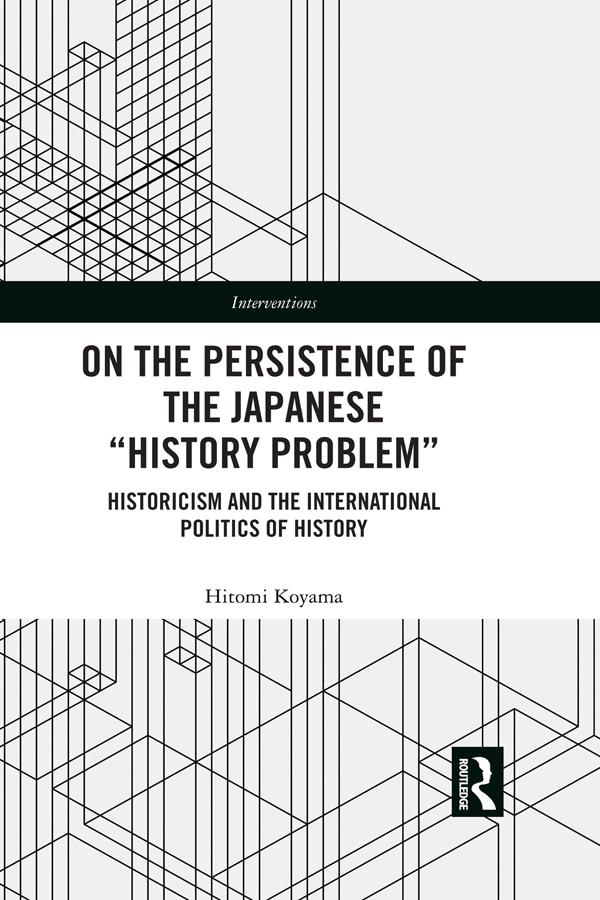
In Japan, people often refer to August 15, 1945 as the end of "that war." But the duration of "that war" remains vague. At times, it refers to the fifteen years of war in the Asia-Pacific. At others, it refers to an imagination of the century long struggle between the East and the West that characterized much of the 19th century. This latter dramatization in particular reinforces longstanding Eurocentric and Orientalist discourses about historical development that presume the non-West lacks historical agency. Nearly 75 years since the nominal end of the war, Japan’s "history problem" – a term invoking the nation’s inability to come to terms with its imperial past – persists throughout Asia today.
Going beyond well-worn clichés about the state’s use and abuse of discourses of historical modernity, Koyama shows how the inability to confront the debris of empire is tethered to the deferral of agency to a hegemonic order centered on the United States. The present is thus a moment one stitched between the disavowal of responsibility on the one hand, and the necessity of becoming a proper subject of history on the other. Behind this seeming impasse lay questions about how to imagine the state as the subject of history in a postcolonial moment – after grand narratives, after patriotism, and after triumphalism.
Pay easily by card, Klarna, Apple Pay or Google Pay. Not happy? You always have a 14-day money-back guarantee. Read more in our terms. If you have any questions, email us at hello@memmo.org.
Memmo makes studying easier – wherever you are in the world. We bring your course books and smart study tools together in one place: summaries, quizzes, podcasts and flashcards. Plus Ted, your study buddy who answers anything you wonder. Over 50,000 students already study here – built to help you learn faster and stress less.