
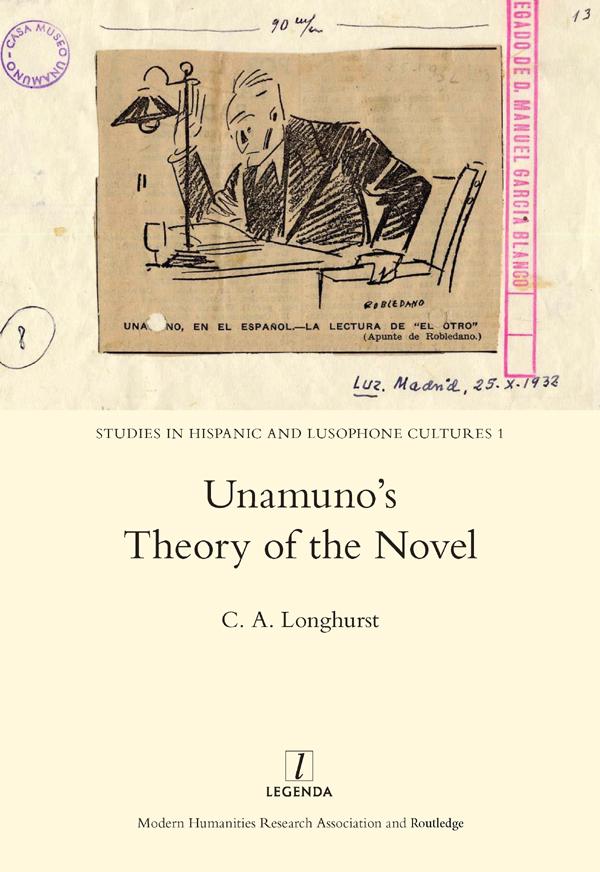
Miguel de Unamuno (1864-1936) is widely regarded as Spain's greatest and most controversial writer of the first half of the twentieth century. Professor of Greek, and later Rector, at the University of Salamanca, and a figure with a noted public profile in his day, he wrote a large number of philosophical, political and philological essays, as well as poems, plays and short stories, but it is his highly idiosyncratic novels, for which he coined the word nivola, that have attracted the greatest critical attention. Niebla (Mist, 1914) has become one of the most studied works of Spanish literature, such is the enduring fascination which it has provoked. In this study, C. A. Longhurst, a distinguished Unamuno scholar, sets out to show that behind Unamuno's fictional experiments there lies a coherent and quasi-philosophical concept of the novelesque genre and indeed of writing itself. Ideas about freedom, identity, finality, mutuality and community are closely intertwined with ideas on writing and reading and give rise to a new and highly personal way of conceiving fiction.
Pages: 227
Category: Litteraturvetenskap & Teori
e-ISBN: 9781351538206
Shipping weight: 1.2 kg
Ships in: 1-2 days
Pay easily by card, Klarna, Apple Pay or Google Pay. Not happy? You always have a 14-day money-back guarantee. Read more in our terms. If you have any questions, email us at hello@memmo.org.
Memmo makes studying easier – wherever you are in the world. We bring your course books and smart study tools together in one place: summaries, quizzes, podcasts and flashcards. Plus Ted, your study buddy who answers anything you wonder. Over 50,000 students already study here – built to help you learn faster and stress less.
You might also like
Buy the book0