
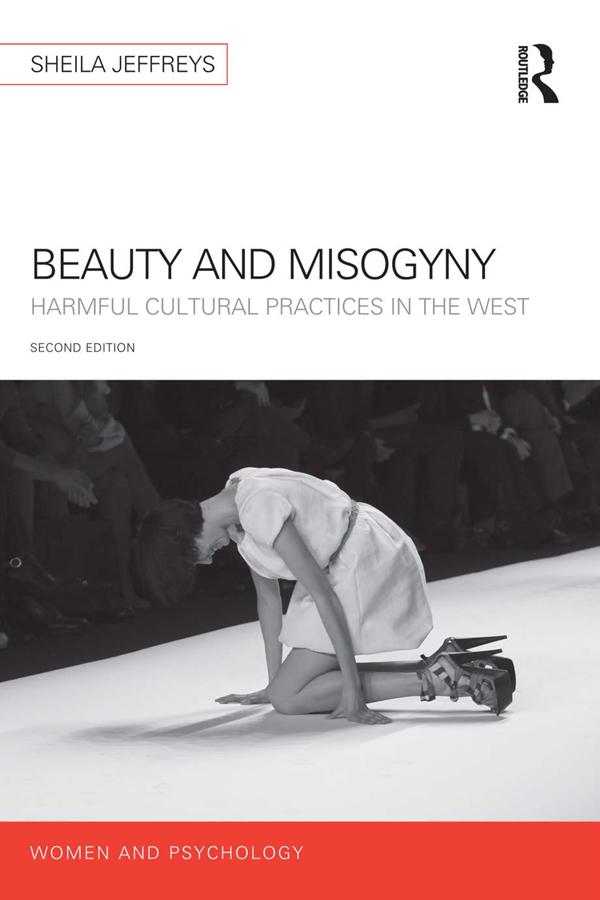
The new edition of Beauty and Misogyny revisits and updates Sheila Jeffreys' uncompromising critique of Western beauty practice and the industries and ideologies behind it. Jeffreys argues that beauty practices are not related to individual female choice or creative expression, but represent instead an important aspect of women's oppression. As these practices have become increasingly brutal and pervasive, the need to scrutinize and dismantle them is if anything more urgent now as it was in 2005 when the first edition of the book was published.
The United Nations concept of "harmful traditional/cultural practices" provides a useful lens for the author to advance her critique. She makes the case for including Western beauty practices within this definition, examining their role in damaging women's health, creating sexual difference and enforcing female deference.
First-wave feminists of the 1970s criticized pervasive beauty regimes such as dieting and depilation, but a later argument took hold that beauty practices were no longer oppressive now that women could "choose" them. In recent years the reality of Western beauty practices has become much more bloody and severe, requiring the breaking of skin and the rearrangement or amputation of body parts. Beauty and Misogyny seeks to make sense of why beauty practices have not only persisted but become more extreme. It examines the pervasive use of makeup, the misogyny of fashion and high-heeled shoes, and looks at the role of pornography in the creation of increasingly popular beauty practices such as breast implants, genital waxing, surgical alteration of the labia and other forms of self-mutilation. The book concludes by considering how a culture of resistance to these practices can be created.
A new and thoroughly updated edition of this essential work will appeal to all levels of students and teachers of gender studies, cultural studies and feminist psychology, and to anyone with an interest in feminism, women and beauty, and women's health.
Pay easily by card, Klarna, Apple Pay or Google Pay. Not happy? You always have a 14-day money-back guarantee. Read more in our terms. If you have any questions, email us at hello@memmo.org.
Memmo makes studying easier – wherever you are in the world. We bring your course books and smart study tools together in one place: summaries, quizzes, podcasts and flashcards. Plus Ted, your study buddy who answers anything you wonder. Over 50,000 students already study here – built to help you learn faster and stress less.