
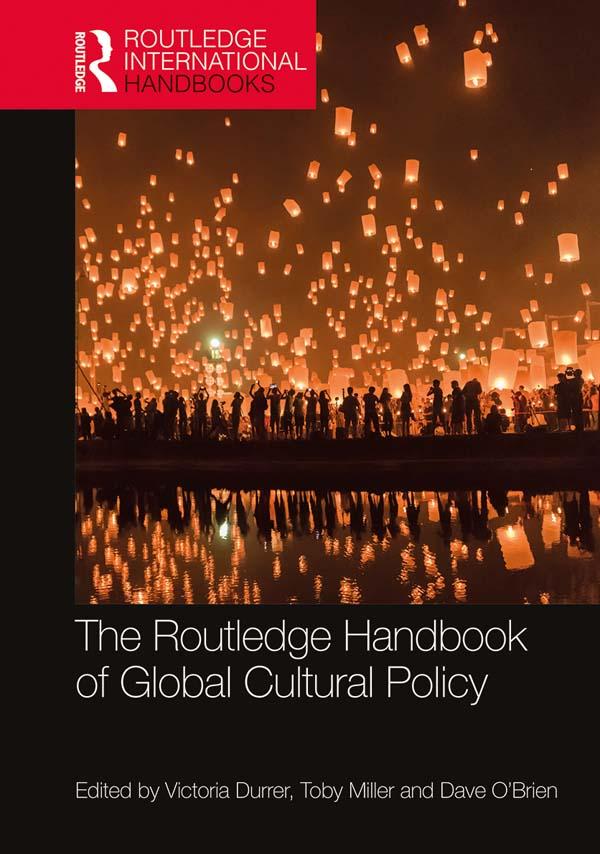
Cultural policy intersects with political, economic, and socio-cultural dynamics at all levels of society, placing high and often contradictory expectations on the capabilities and capacities of the media, the fine, performing, and folk arts, and cultural heritage. These expectations are articulated, mobilised and contested at – and across – a global scale. As a result, the study of cultural policy has firmly established itself as a field that cuts across a range of academic disciplines, including sociology, cultural and media studies, economics, anthropology, area studies, languages, geography, and law. This Routledge Handbook of Global Cultural Policy sets out to broaden the field’s consideration to recognise the necessity for international and global perspectives.
The book explores how cultural policy has become a global phenomenon. It brings together a diverse range of researchers whose work reveals how cultural policy expresses and realises common global concerns, dominant narratives, and geopolitical economic and social inequalities. The sections of the book address cultural policy’s relation to core academic disciplines and core questions, of regulations, rights, development, practice, and global issues.
With a cross-section of country-by-country case studies, this comprehensive volume is a map for academics and students seeking to become more globally orientated cultural policy scholars.
Pay easily by card, Klarna, Apple Pay or Google Pay. Not happy? You always have a 14-day money-back guarantee. Read more in our terms. If you have any questions, email us at hello@memmo.org.
Memmo makes studying easier – wherever you are in the world. We bring your course books and smart study tools together in one place: summaries, quizzes, podcasts and flashcards. Plus Ted, your study buddy who answers anything you wonder. Over 50,000 students already study here – built to help you learn faster and stress less.