
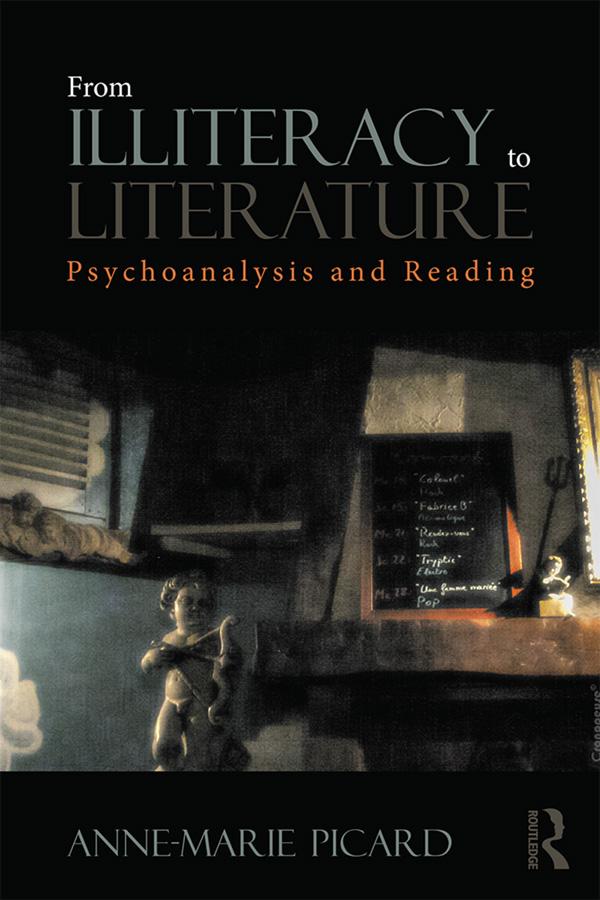
From Illiteracy to Literature presents innovative material based on research with ‘non-reading’ children and re-examines the complex relationship between psychoanalysis and literature, through the lens of the psychical significance of reading: the forgotten adventure of our coming to reading.
Anne-Marie Picard draws on two specific fields of interest: firstly the wish to understand the nature of literariness or the "literary effect", i.e. the pleasures (and frustrations) we derive from reading; secondly research on reading pathologies carried out at St Anne’s Hospital, Paris. The author uses clinical observations of non-reading children to answer literary questions about the reading experience, using psychoanalytic theory as a conceptual framework. The notion that reading difficulties or phobias should be seen as a symptom in the psychoanalytic sense, allows Picard to shed light on both clinical vignettes taken from children’s case histories and reading scenes from literary texts.
Children experiencing difficulties in learning to read highlight the imaginary stakes of the confrontation with the arbitrary nature of the letter and the "price to pay" for one’s entrance into the Symbolic. Picard applies the lesson "taught" by these children to a series of key literary texts featuring, at their very core, this confrontation with the signifier, with the written code itself.. This book argues that there is something in literature that drives us back, again and again, to the loss we have suffered as human beings, to what we had to undergo to become human: our subjection to the common place of language. Picard shows complex Lacanian concepts "at work" in the field of reading pathologies, emphasizing close reading and a clinical attention to the "letter" of the texts, far from the "psychobiographical" attempts at psychologizing literary authors.
From Illiteracy to Literature presents a novel psychodynamic approach that will be of great interest to psychotherapists and language pathologists, appealing to literary scholars and those interested in the process of reading and "literariness."
Pay easily by card, Klarna, Apple Pay or Google Pay. Not happy? You always have a 14-day money-back guarantee. Read more in our terms. If you have any questions, email us at hello@memmo.org.
Memmo makes studying easier – wherever you are in the world. We bring your course books and smart study tools together in one place: summaries, quizzes, podcasts and flashcards. Plus Ted, your study buddy who answers anything you wonder. Over 50,000 students already study here – built to help you learn faster and stress less.