
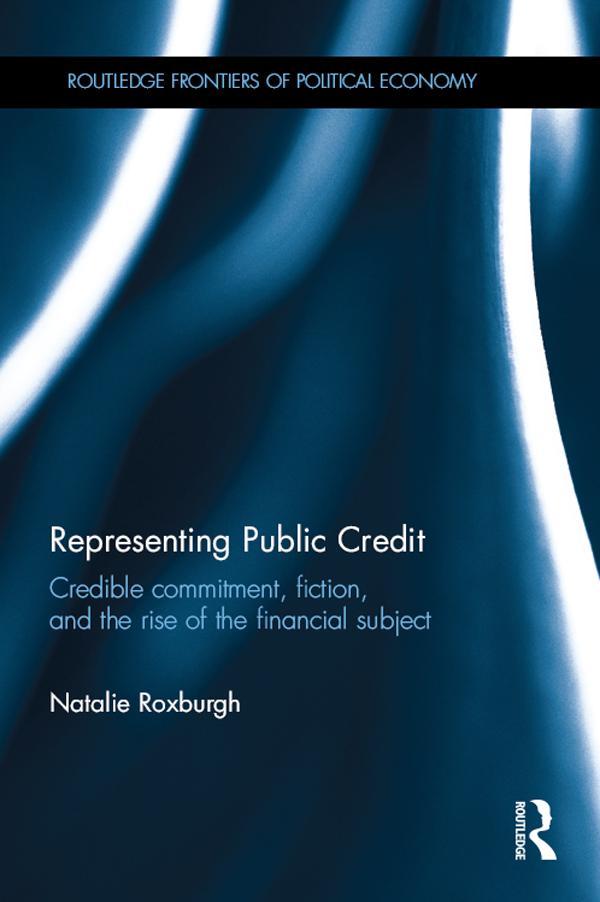
Public credit was controversial in seventeenth- and eighteenth-century England. It entailed new ways of thinking about the individual in relation to the State and was for many reasons a site of cultural negotiation and debate. At the same time, it required commitment from participants in order to function. Some of the debates relating to public credit, whose success was tied up in the way it was represented, find their way into contemporary fiction – in particular the eighteenth-century novel.
This book reads eighteenth-century fiction alongside works of political economy in order to offer a new perspective on credible commitment and the rise of a credit economy facilitated by public credit. Works by authors such as Daniel Defoe, Samuel Richardson, and Frances Burney are explored alongside lesser-known fictional texts, including some early it-narratives and novels of sensibility, to give a fully rounded view of the perception of public credit within England and its wider cultural and social implications. Strategies for representing public credit, the book argues, can be seen as contributing to the development of the English novel, a type of fiction whose emphasis on the individual can also be read as helping to produce a certain type of person, the modern financial subject.
This interdisciplinary book draws from economic history and literary/cultural studies in order to make connections between the development of finance and an important facet of modern Western culture, the novel.
Pay easily by card, Klarna, Apple Pay or Google Pay. Not happy? You always have a 14-day money-back guarantee. Read more in our terms. If you have any questions, email us at hello@memmo.org.
Memmo makes studying easier – wherever you are in the world. We bring your course books and smart study tools together in one place: summaries, quizzes, podcasts and flashcards. Plus Ted, your study buddy who answers anything you wonder. Over 50,000 students already study here – built to help you learn faster and stress less.