
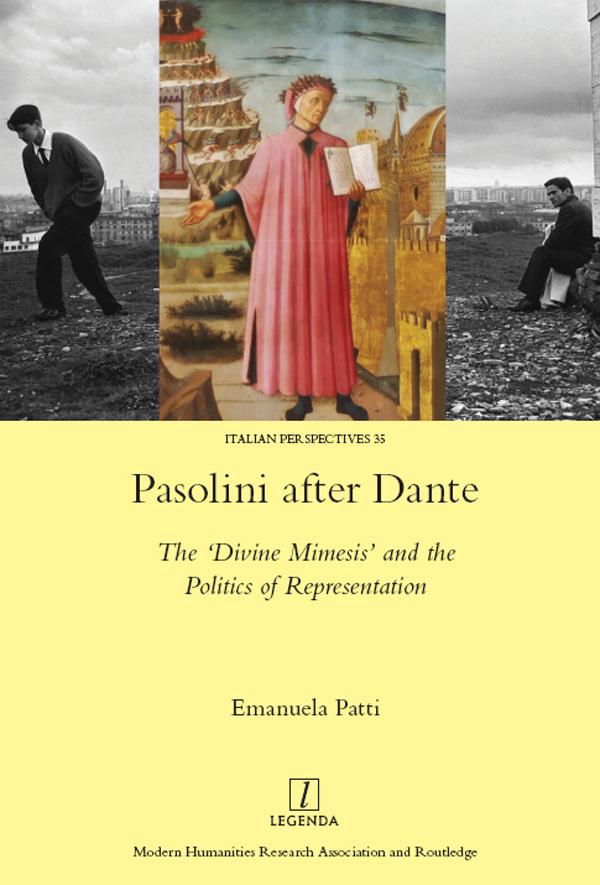
What role did Dante play in the work of Pier Paolo Pasolini (1922-1975)? His unfinished and fragmented imitation of the Comedia, La Divina Mimesis, is only one outward sign of what was a sustained dialogue with Dante on representation begun in the early 1950s. During this period, the philologists Gianfranco Contini (1912-1990) and Erich Auerbach (1892-1957) played a crucial role in Pasolini’s re-thinking of ‘represented reality’, suggesting Dante as the best literary, authorial and political model for a generation of postwar Italian writers. This emerged first as ‘Dantean realism’ in Pasolini’s prose and poetry, after Contini’s interpretation of Dante and of his plurilingualism, and then as ‘figural realism’ in his cinema, after Auerbach’s concepts of Dante’s figura and ‘mingling of styles’. Following the evolution of Pasolini’s mimetic ideal from these formative influences through to La Divina Mimesis, Emanuela Patti explores Pasolini’s politics of representation in relation to the ‘national-popular’, the ‘questione della lingua’ and the Italian post-war debates on neorealism, while also providing a new interpretation of some of his major literary and cinematic works.
Pay easily by card, Klarna, Apple Pay or Google Pay. Not happy? You always have a 14-day money-back guarantee. Read more in our terms. If you have any questions, email us at hello@memmo.org.
Memmo makes studying easier – wherever you are in the world. We bring your course books and smart study tools together in one place: summaries, quizzes, podcasts and flashcards. Plus Ted, your study buddy who answers anything you wonder. Over 50,000 students already study here – built to help you learn faster and stress less.