
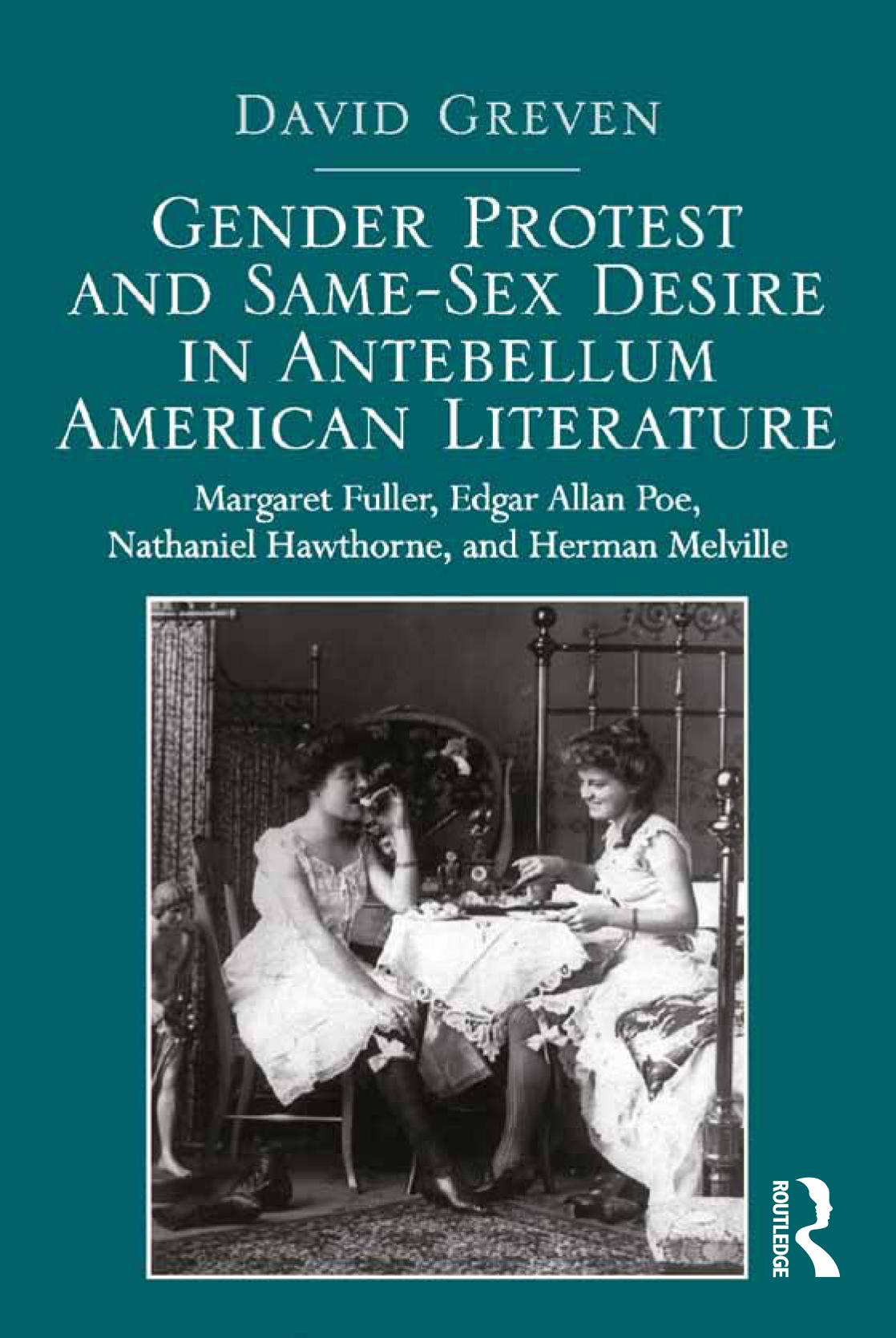
Expanding our understanding of the possibilities and challenges inherent in the expression of same-sex desire before the Civil War, David Greven identifies a pattern of what he calls ’gender protest’ and sexual possibility recurring in antebellum works. He suggests that major authors such as Margaret Fuller, Edgar Allan Poe, Herman Melville, and Nathaniel Hawthorne consciously sought to represent same-sex desire in their writings. Focusing especially on conceptions of the melancholia of gender identification and shame, Greven argues that same-sex desire was inextricably enmeshed in scenes of gender-role strain, as exemplified in the extent to which The Narrative of Arthur Gordon Pym depicts masculine identity adrift and in disarray. Greven finds similarly compelling representations of gender protest in Fuller’s exploration of the crisis of gendered identity in Summer on the Lakes, in Melville’s representation of Redburn’s experience of gender nonconformity, and in Hawthorne’s complicated delineation of desire in The Scarlet Letter. As Greven shows, antebellum authors not only took up the taboo subjects of same-sex desire and female sexuality, but were adept in their use of a variety of rhetorical means for expressing the inexpressible.
Pay easily by card, Klarna, Apple Pay or Google Pay. Not happy? You always have a 14-day money-back guarantee. Read more in our terms. If you have any questions, email us at hello@memmo.org.
Memmo makes studying easier – wherever you are in the world. We bring your course books and smart study tools together in one place: summaries, quizzes, podcasts and flashcards. Plus Ted, your study buddy who answers anything you wonder. Over 50,000 students already study here – built to help you learn faster and stress less.
You might also like
Buy the book0