
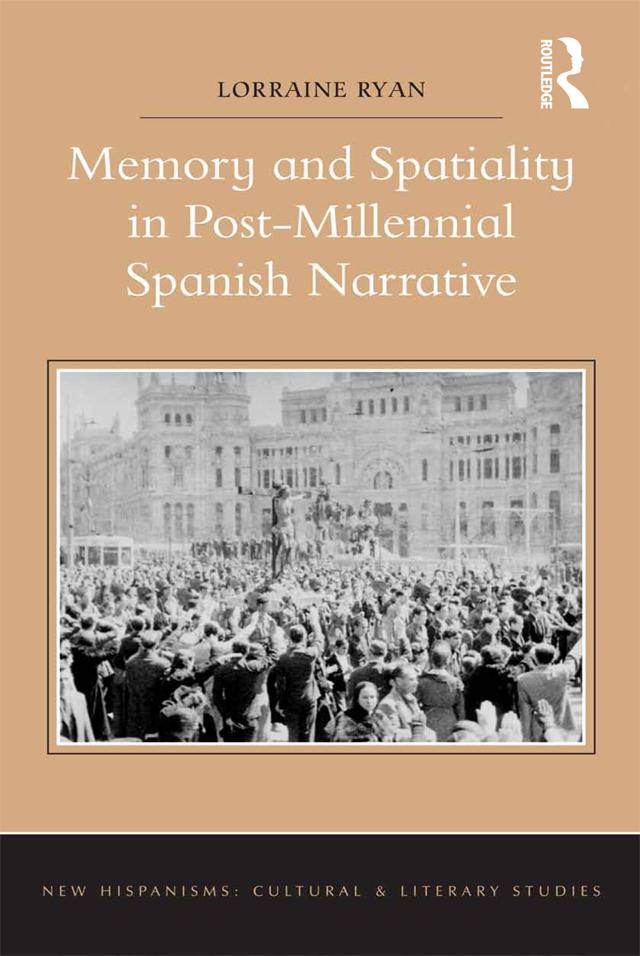
Focusing on literary texts produced from 2000 to 2009, Lorraine Ryan examines the imbrication between the preservation of Republican memory and the transformations of Spanish public space during the period from 1931 to 2005. Accordingly, Ryan analyzes the spatial empowerment and disempowerment of Republican memory and identity in Dulce Chacón’s Cielos de barro, Ãngeles López’s Martina, la rosa número trece, Alberto Méndez’s ’Los girasoles ciegos,’ Carlos Ruiz Zafón´s La sombra del viento, Emili Teixidor’s Pan negro, Bernardo Atxaga’s El hijo del acordeonista, and José MarÃa Merino’s La sima. The interrelationship between Republican subalternity and space is redefined by these writers as tense and constantly in flux, undermined by its inexorable relationality, which leads to subjects endeavoring to instill into space their own values. Subjects erode the hegemonic power of the public space by articulating in an often surreptitious form their sense of belonging to a prohibited Republican memory culture. In the democratic period, they seek a categorical reinstatement of same on the public terrain. Ryan also considers the motivation underlying this coterie of authors’ commitment to the issue of historical memory, an analysis which serves to amplify the ambits of existing scholarship that tends to ascribe it solely to postmemory.
Pay easily by card, Klarna, Apple Pay or Google Pay. Not happy? You always have a 14-day money-back guarantee. Read more in our terms. If you have any questions, email us at hello@memmo.org.
Memmo makes studying easier – wherever you are in the world. We bring your course books and smart study tools together in one place: summaries, quizzes, podcasts and flashcards. Plus Ted, your study buddy who answers anything you wonder. Over 50,000 students already study here – built to help you learn faster and stress less.
You might also like
Buy the book0