
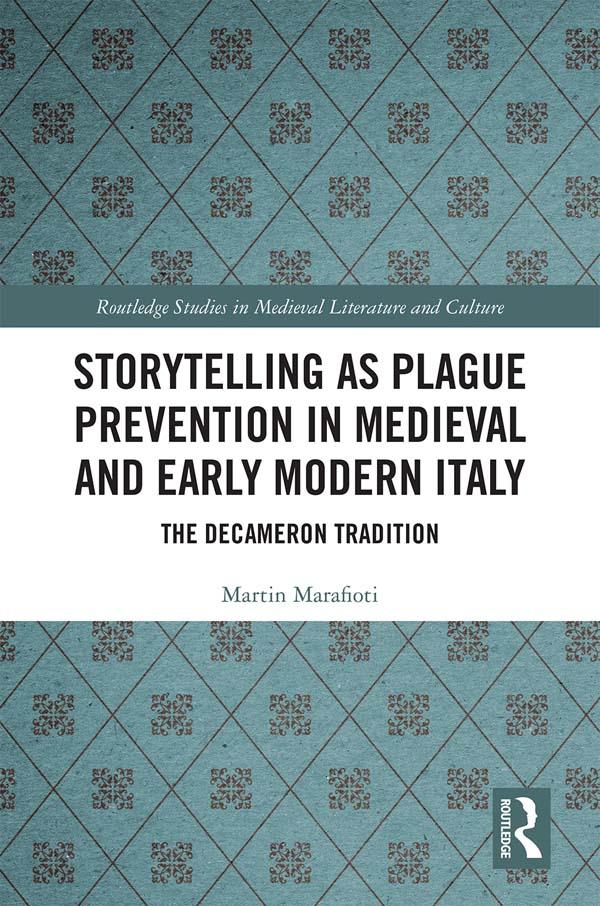
Through close readings of five Italian collections of novellas written over a 500-year period, Martin Marafioti explores the literary tradition of storytelling, and particularly its efficacy as a healing tool following traumatic visitations from the plague. In this study, Giovanni Boccaccio's Decameron provides the framework for later authors. Although Boccaccio was not the first writer to deal with pestilence or epidemics in a literary work, he was the first to unite the topos of a life-threatening context with a public health disaster like the Black Death, and certainly the first author to propose storytelling as a means of prophylaxis in times of plague. Marafioti goes on to analyze Franco Sacchetti's Trecento Novelle, Giovanni Sercambi's Novelliere, Celio Malespini's Duecento Novelle, and Francesco Argelati's Decamerone, following in its longue-durée the ups and down, structurally and thematically, of the realistic novella as a genre.
Pay easily by card, Klarna, Apple Pay or Google Pay. Not happy? You always have a 14-day money-back guarantee. Read more in our terms. If you have any questions, email us at hello@memmo.org.
Memmo makes studying easier – wherever you are in the world. We bring your course books and smart study tools together in one place: summaries, quizzes, podcasts and flashcards. Plus Ted, your study buddy who answers anything you wonder. Over 50,000 students already study here – built to help you learn faster and stress less.
You might also like
Buy the book0