
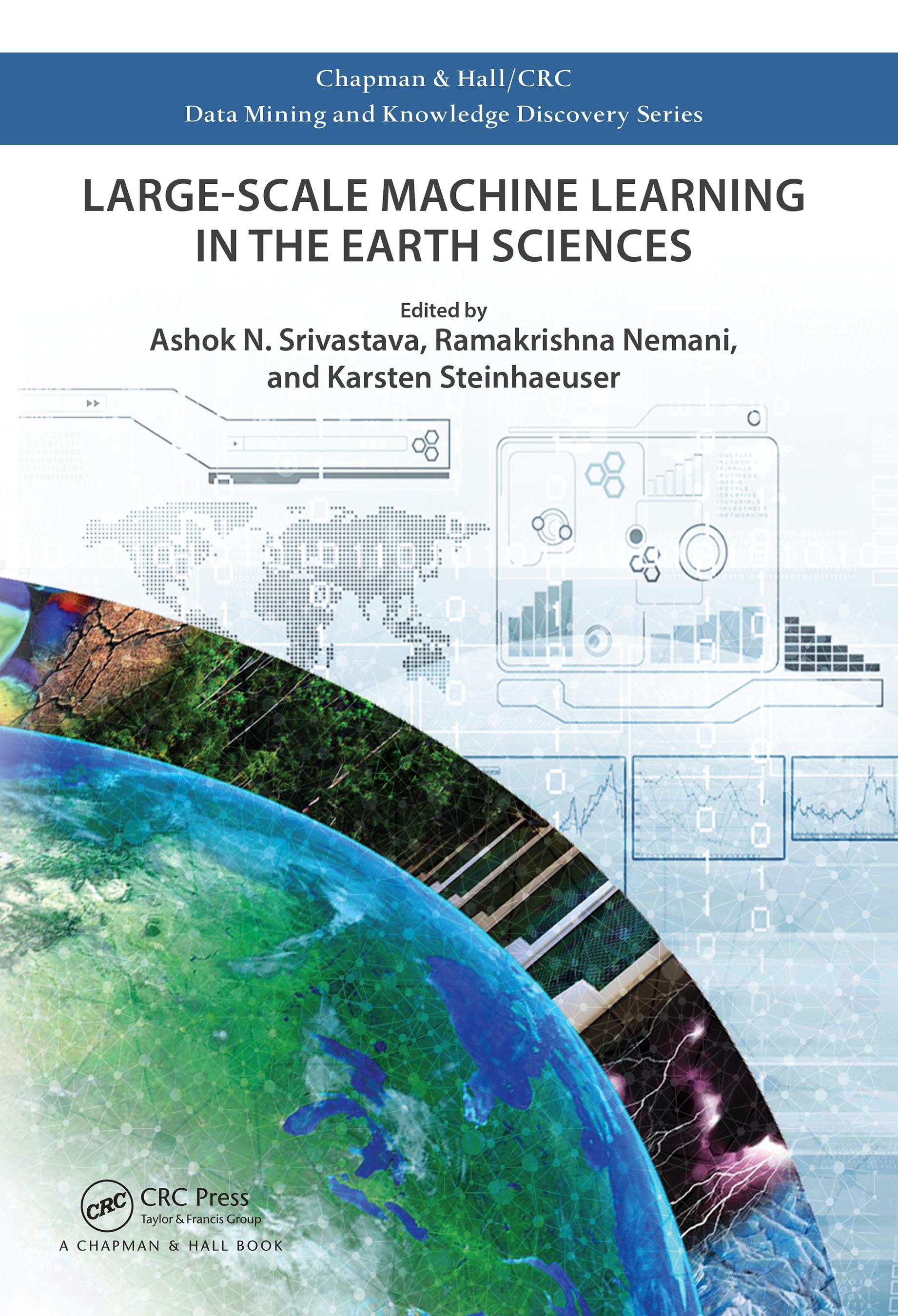
From the Foreword:
"While large-scale machine learning and data mining have greatly impacted a range of commercial applications, their use in the field of Earth sciences is still in the early stages. This book, edited by Ashok
Srivastava, Ramakrishna Nemani, and Karsten Steinhaeuser, serves as an outstanding resource for anyone interested in the opportunities and challenges for the machine learning community in analyzing these data sets to answer questions of urgent societal interest…I hope that this book will inspire more computer scientists to focus on environmental applications, and Earth scientists to seek collaborations with researchers in machine learning and data mining to advance the frontiers in Earth sciences."
--Vipin Kumar, University of Minnesota
Large-Scale Machine Learning in the Earth Sciences provides researchers and practitioners with a broad overview of some of the key challenges in the intersection of Earth science, computer science, statistics, and related fields. It explores a wide range of topics and provides a compilation of recent research in the application of machine learning in the field of Earth Science.
Making predictions based on observational data is a theme of the book, and the book includes chapters on the use of network science to understand and discover teleconnections in extreme climate and weather events, as well as using structured estimation in high dimensions. The use of ensemble machine learning models to combine predictions of global climate models using information from spatial and temporal patterns is also explored.
The second part of the book features a discussion on statistical downscaling in climate with state-of-the-art scalable machine learning, as well as an overview of methods to understand and predict the proliferation of biological species due to changes in environmental conditions. The problem of using large-scale machine learning to study the formation of tornadoes is also explored in depth.
The last part of the book covers the use of deep learning algorithms to classify images that have very high resolution, as well as the unmixing of spectral signals in remote sensing images of land cover. The authors also apply long-tail distributions to geoscience resources, in the final chapter of the book.
Pay easily by card, Klarna, Apple Pay or Google Pay. Not happy? You always have a 14-day money-back guarantee. Read more in our terms. If you have any questions, email us at hello@memmo.org.
Memmo makes studying easier – wherever you are in the world. We bring your course books and smart study tools together in one place: summaries, quizzes, podcasts and flashcards. Plus Ted, your study buddy who answers anything you wonder. Over 50,000 students already study here – built to help you learn faster and stress less.