
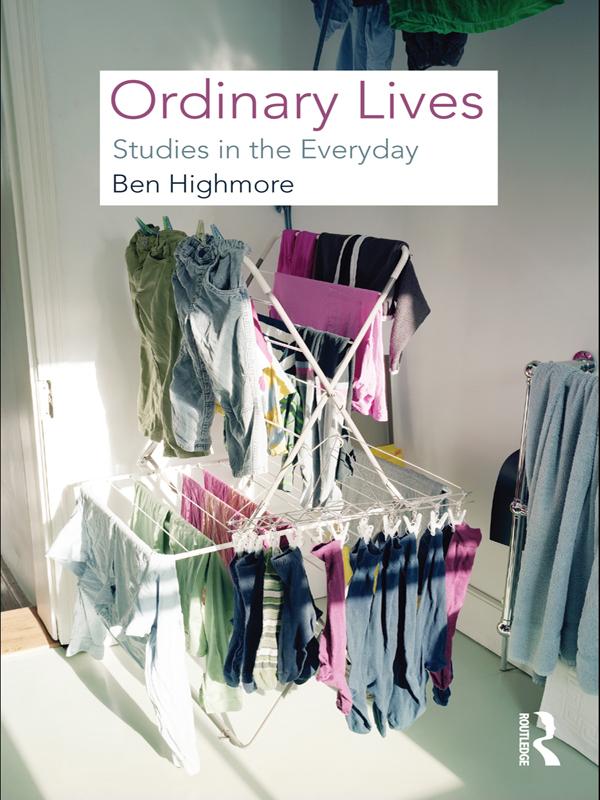
This new study from Ben Highmore looks at the seemingly banal world of objects, work, daily media, and food, and finds there a scintillating array of passionate experience. Through a series of case studies, and building on his previous work on the everyday, Highmore examines our relationship to familiar objects (a favourite chair), repetitive work (housework, typing), media (distracted television viewing and radio listening) and food (specifically the food of multicultural Britain). A chair allows him to consider the history of flat-pack furniture as well as the lively presence of inorganic ‘stuff’ in our daily lives. Distracted television watching and radio listening becomes one of the preconditions for experiencing wonder through the media.
Ordinary Lives links the concrete study of routine existence to theoretical reflection on everyday life. The book discusses philosophers such as Jacques Rancière, William James and David Hume and combines them with autobiographical testimonies, historical research and the analysis of popular culture to investigate the minutiae of day-to-day life. Highmore argues that aesthetic experience is embedded in the mundane sensory world of everyday life. He asks the reader to reconsider the negative associations of habit and routine, focusing specifically on the intrinsic ambiguity of habit (habit, we find out, is both rigid and adaptive). Rather than ask ‘what does everyday life mean?’ this book asks ‘what does everyday life feel like and how do our sensual, emotional and temporal experiences interconnect and intersect?’
Ordinary Lives is an accessible, animated and engaging book that is ideally suited to both students and researchers working in cultural studies, media and communication and sociology.
Pay easily by card, Klarna, Apple Pay or Google Pay. Not happy? You always have a 14-day money-back guarantee. Read more in our terms. If you have any questions, email us at hello@memmo.org.
Memmo makes studying easier – wherever you are in the world. We bring your course books and smart study tools together in one place: summaries, quizzes, podcasts and flashcards. Plus Ted, your study buddy who answers anything you wonder. Over 50,000 students already study here – built to help you learn faster and stress less.