
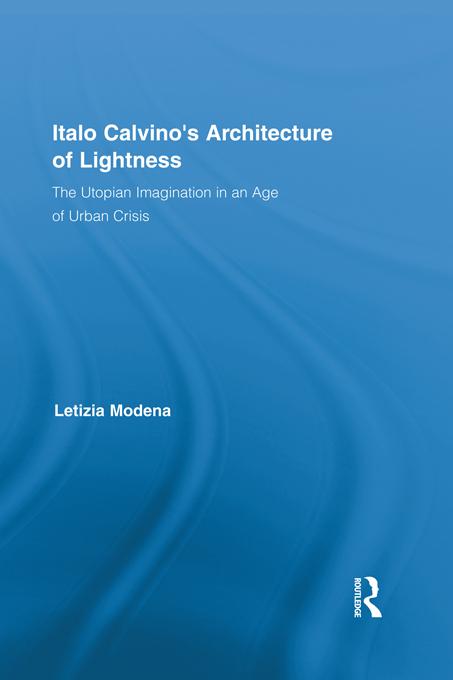
This study recovers Italo Calvino's central place in a lost history of interdisciplinary thought, politics, and literary philosophy in the 1960s. Drawing on his letters, essays, critical reviews, and fiction, as well as a wide range of works--primarily urban planning and design theory and history--circulating among his primary interlocutors, this book takes as its point of departure a sweeping reinterpretation of Invisible Cities. Passages from Calvino's most famous novel routinely appear as aphorisms in calendars, posters, and the popular literature of inspiration and self-help, reducing the novel to vague abstractions and totalizing wisdom about thinking outside the box. The shadow of postmodern studies has had a similarly diminishing effect on this text, rendering up an accomplished but ultimately apolitical novelistic experimentation in endless deconstructive deferrals, the shiny surfaces of play, and the ultimately rigged game of self-referentiality. In contrast, this study draws on an archive of untranslated Italian- and French-language materials on urban planning, architecture, and utopian architecture to argue that Calvino's novel in fact introduces readers to the material history of urban renewal in Italy, France, and the U.S. in the 1960s, as well as the multidisciplinary core of cultural life in that decade: the complex and continuous interplay among novelists and architects, scientists and artists, literary historians and visual studies scholars. His last love poem for the dying city was in fact profoundly engaged, deeply committed to the ethical dimensions of both architecture and lived experience in the spaces of modernity as well as the resistant practices of reading and utopian imagining that his urban studies in turn inspired.
Pay easily by card, Klarna, Apple Pay or Google Pay. Not happy? You always have a 14-day money-back guarantee. Read more in our terms. If you have any questions, email us at hello@memmo.org.
Memmo makes studying easier – wherever you are in the world. We bring your course books and smart study tools together in one place: summaries, quizzes, podcasts and flashcards. Plus Ted, your study buddy who answers anything you wonder. Over 50,000 students already study here – built to help you learn faster and stress less.