
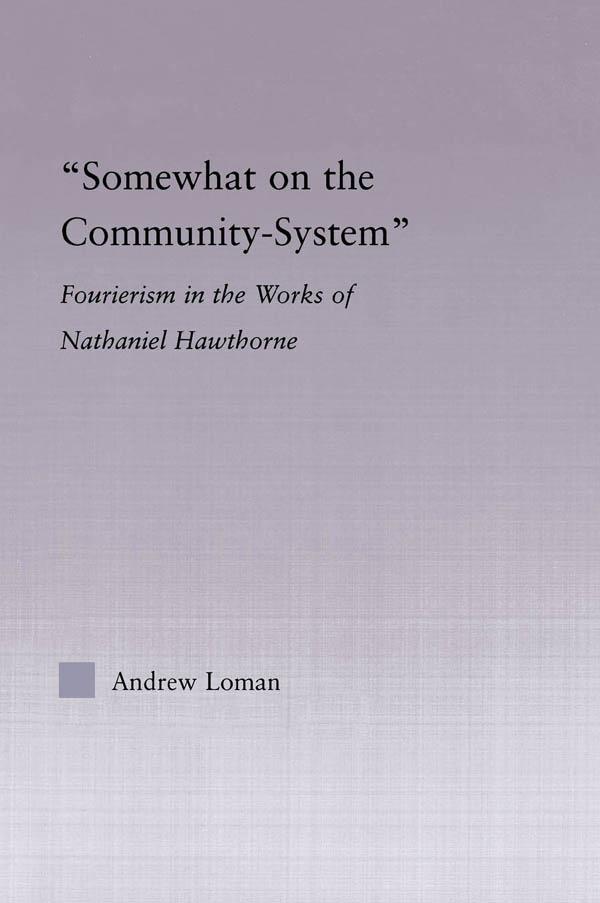
Hawthorne wrote much of his major fiction in the decade that the theories of Charles Marie François Fourier crossed the Atlantic and contributed to a wave of communitarian experimentation in the American North. Famously, Hawthorne briefly lived and worked at Brook Farm, a Transcendentalist commune that formally converted to Fourierism when he had left and was embroiled in litigation to recover money he had invested in the community. In his fiction, Hawthorne responded directly to Fourierism and its critique of capitalism. He used his experiences at Brook Farm as the inspiration for The Blithedale Romance, and in The House of the SevenGables cast one of the principal characters as a recovering Fourierist. In The Scarlet Letter he engaged with Fourierist debates on marriage and the regulation of desire. Somewhat on the Community-System examines these interventions, and argues that Hawthorne's fiction both seeks to contain Fourierism and responds to its allure. Moreover, in formulating alternative, morally acceptable utopias (ones that are predicated on middle-class marriage), Hawthorne's fiction appropriates key aspects of Fourierist theory
Pay easily by card, Klarna, Apple Pay or Google Pay. Not happy? You always have a 14-day money-back guarantee. Read more in our terms. If you have any questions, email us at hello@memmo.org.
Memmo makes studying easier – wherever you are in the world. We bring your course books and smart study tools together in one place: summaries, quizzes, podcasts and flashcards. Plus Ted, your study buddy who answers anything you wonder. Over 50,000 students already study here – built to help you learn faster and stress less.