
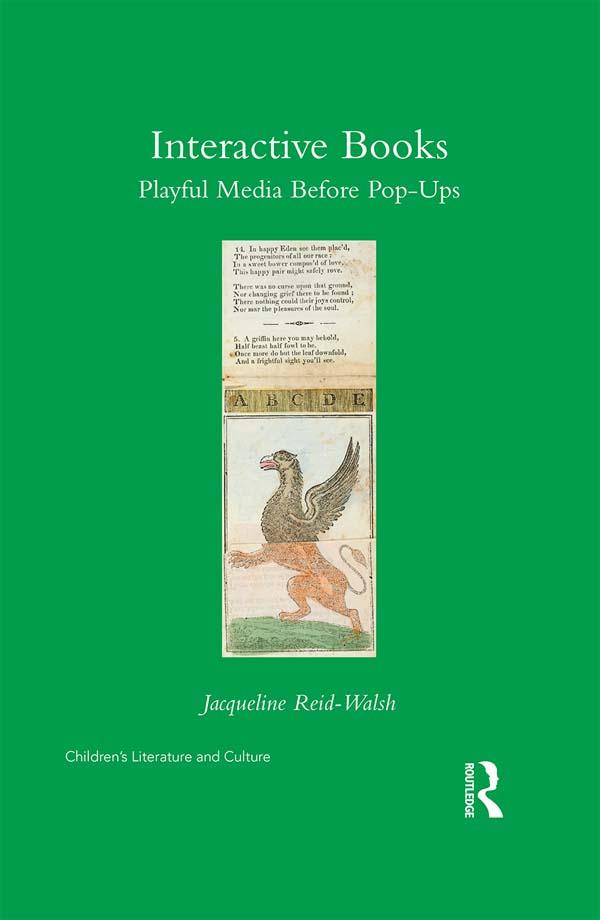
Movable books are an innovative area of children’s publishing. Commonly equated with spectacular pop-ups, movable books have a little-known history as interactive, narrative media. Since they are hybrid artifacts consisting of words, images and movable components, they cross the borders between story, toy, and game. Interactive Books is a historical and comparative study of early movable books in relation to the children who engage with them.
Jacqueline Reid-Walsh focuses on the period movable books became connected with children from the mid-17th to the early-19th centuries. In particular, she examines turn-up books, paper doll books, and related hybrid experiments like toy theaters and paignion (or domestic play set) produced between 1650 and 1830. Despite being popular in their own time, these artifacts are little known today. This study draws attention to a gap in our knowledge of children’s print culture by showing how these artifacts are important in their own right.
Reid-Walsh combines archival research with children’s literature studies, book history, and juvenilia studies. By examining commercially produced and homemade examples, she explores the interrelations among children, interactive media, and historical participatory culture. By drawing on both Enlightenment thinkers and contemporary digital media theorists Interactive Books enables us to think critically about children’s media texts paper and digital, past and present.
Pay easily by card, Klarna, Apple Pay or Google Pay. Not happy? You always have a 14-day money-back guarantee. Read more in our terms. If you have any questions, email us at hello@memmo.org.
Memmo makes studying easier – wherever you are in the world. We bring your course books and smart study tools together in one place: summaries, quizzes, podcasts and flashcards. Plus Ted, your study buddy who answers anything you wonder. Over 50,000 students already study here – built to help you learn faster and stress less.