
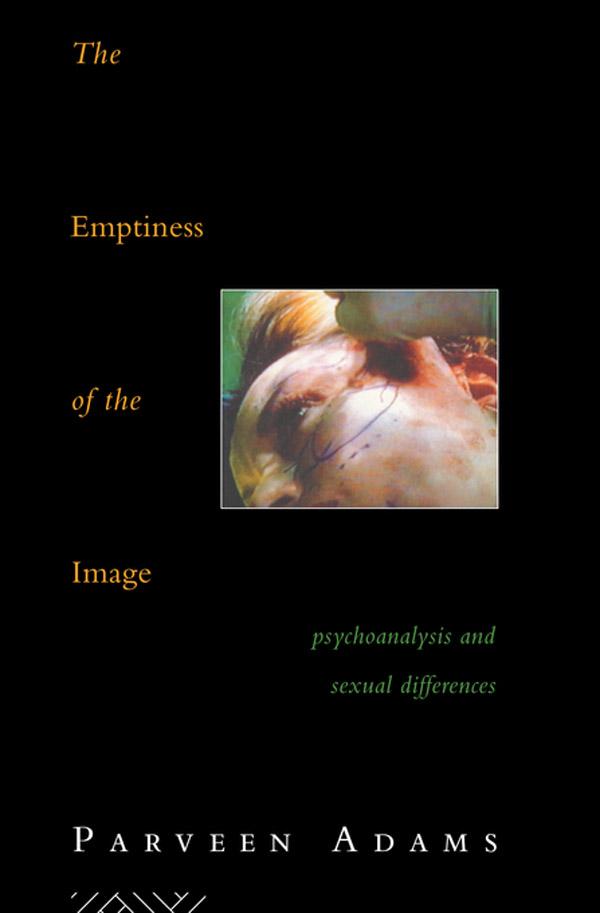
There has long been a politics around the way in which women are represented, with objection not so much to specific images as to a regime of looking which places the represented woman in a particular relationship to the spectator's gaze. Artists have sometimes avoided the representation of women altogether, but they are now producing images which challenge the regime. How do these images succeed in their challenge ?
The Emptiness of the Image offers a psychoanalytic answer. Parveen Adams argues that, despite flaws in some of the details of its arguments, psychoanalytic theory retains an overwhelming explanatory strength in relation to questions of sexual difference and representation. She goes on to show how the issue of desire changes the way we can think of images and their effects. Throughout she discusses the work of theorists, artists and filmmakers such as Helene Deutsch, Catherine MacKinnon, Mary Kelly, Francis Bacon, Michael Powell and Della Grace.
The Emptiness of the Image shows how the very space of representation can change to provide a new way of thinking the relation between the text and the spectator. It shows how psychoanalytic theory is supple enough to slide into and transform the most unexpected situations.
Pay easily by card, Klarna, Apple Pay or Google Pay. Not happy? You always have a 14-day money-back guarantee. Read more in our terms. If you have any questions, email us at hello@memmo.org.
Memmo makes studying easier – wherever you are in the world. We bring your course books and smart study tools together in one place: summaries, quizzes, podcasts and flashcards. Plus Ted, your study buddy who answers anything you wonder. Over 50,000 students already study here – built to help you learn faster and stress less.
You might also like
Buy the book0