
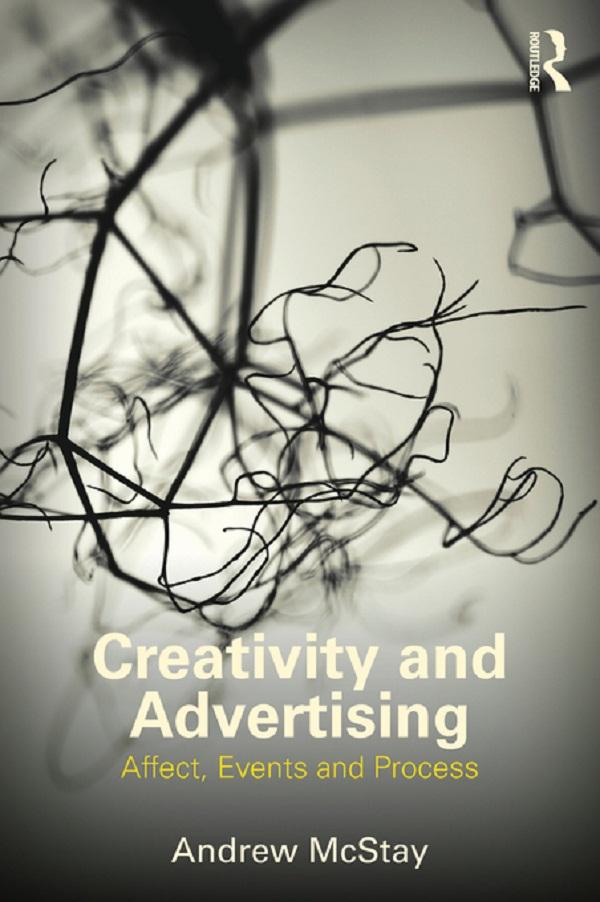
Creativity and Advertising develops novel ways to theorise advertising and creativity. Arguing that combinatory accounts of advertising based on representation, textualism and reductionism are of limited value, Andrew McStay suggests that advertising and creativity are better recognised in terms of the ‘event’. Drawing on a diverse set of philosophical influences including Scotus, Spinoza, Vico, Kant, Schiller, James, Dewey, Schopenhauer, Whitehead, Bataille, Heidegger and Deleuze, the book posits a sensational, process-based, transgressive, lived and embodied approach to thinking about media, aesthetics, creativity and our interaction with advertising.
Elaborating an affective account of creativity, McStay assesses creative advertising from Coke, Evian, Google, Sony, Uniqlo and Volkswagen among others, and articulates the ways in which award-winning creative advertising may increasingly be read in terms of co-production, playfulness, ecological conceptions of media, improvisation, and immersion in fields and processes of corporeal affect.
Philosophically wide-ranging yet grounded in robust understanding of industry practices, the book will also be of use to scholars with an interest in aesthetics, art, design, media, performance, philosophy and those with a general interest in creativity.
Andrew McStay lectures at Bangor University and is author of Digital Advertising, and The Mood of Information: A Critique of Online Behavioural Advertising and Deconstructing Privacy, the latter forthcoming in 2014.
Pay easily by card, Klarna, Apple Pay or Google Pay. Not happy? You always have a 14-day money-back guarantee. Read more in our terms. If you have any questions, email us at hello@memmo.org.
Memmo makes studying easier – wherever you are in the world. We bring your course books and smart study tools together in one place: summaries, quizzes, podcasts and flashcards. Plus Ted, your study buddy who answers anything you wonder. Over 50,000 students already study here – built to help you learn faster and stress less.