
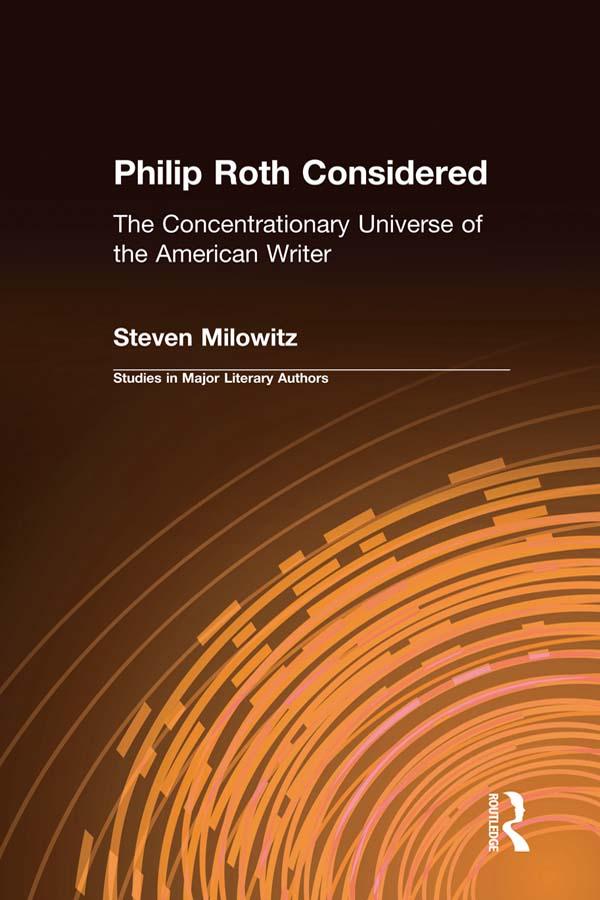
This book comprehensively surveys Philip Roth's published and unpublished works, focusing on the thematic unity which binds them together: the memory of the Holocaust and the altered universe born of that memory. The Holocaust is understood as the orienting event for Roth's fiction and non-fiction, the force that surrounds the characters and the narratives at all times. Roth's obsession with questions of the Holocaust, questions of responsibility, meaning, and powerlessness, explains his recurring discussion of entrapment, dehumanization, nihilism, guilt, and coercion.
The concentrationary universe of the title is defined, in this work, as not only the universe of camps, but also the universe that exists after the devastation. Moral and philosophical norms are revoked in this new world. Roth's early works are presented on a desolate landscape. The introduction explicates this landscape, specifically by invoking an early play of Roth's, a play which is set in a Jewish ghetto during the Holocaust. This unpublished work introduces the historical period that shapes the visions of Roth's future protagonists.
The next three chapters study Roth's relentless excavation of the dilemmas of fathers, mothers, authority figures, and the inner discord of need and purpose. These seemingly quotidian problems are exacerbated and intensified by the Holocaust's shadowy presence. No relationship, no effort at fulfillment, no action is untempered by history in Roth's varied fictions.
Chapters four and five look directly at Roth's allusions to the Holocaust. They explore, through each of Roth's works, how the Holocaust-thematic -the play of ideology and nihilism-and the Holocaust-pattern -the idea of the past encroaching upon the present -work through Roth's career, informing his readers not only of his fascination with the Holocaust, but of his particularly human way of dealing with it.
The last chapter briefly summarizes the findings of the previous chapter and connects Roth's specific concentrationary universe to the larger world. The linguistic clues of Roth's novels are revealed and investigated, pointing to Roth's celebration of ambiguity and individuality as parts of an imperfect formula for writing and living in the debased aftermath of the Holocaust.
Pay easily by card, Klarna, Apple Pay or Google Pay. Not happy? You always have a 14-day money-back guarantee. Read more in our terms. If you have any questions, email us at hello@memmo.org.
Memmo makes studying easier – wherever you are in the world. We bring your course books and smart study tools together in one place: summaries, quizzes, podcasts and flashcards. Plus Ted, your study buddy who answers anything you wonder. Over 50,000 students already study here – built to help you learn faster and stress less.