
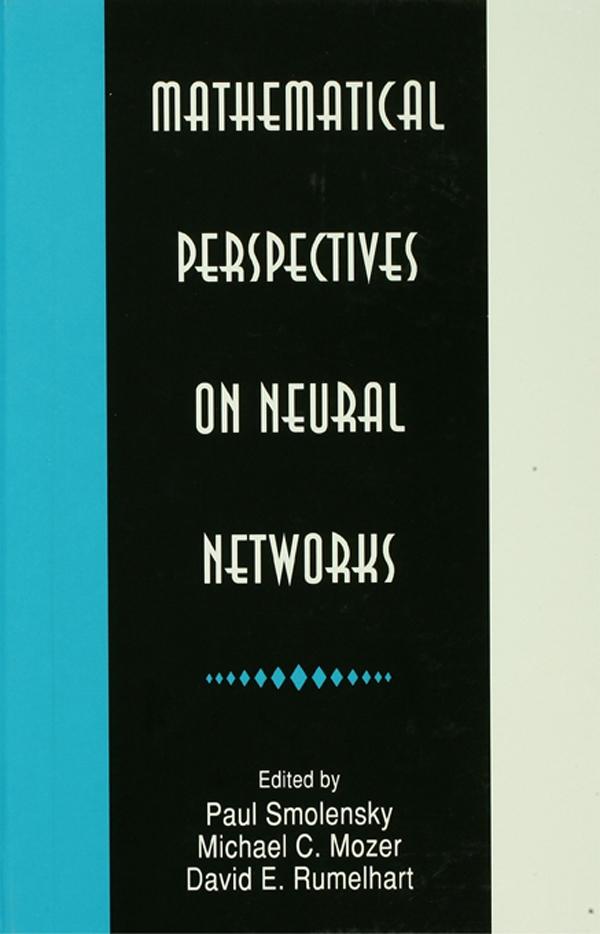
Recent years have seen an explosion of new mathematical results on learning and processing in neural networks. This body of results rests on a breadth of mathematical background which even few specialists possess. In a format intermediate between a textbook and a collection of research articles, this book has been assembled to present a sample of these results, and to fill in the necessary background, in such areas as computability theory, computational complexity theory, the theory of analog computation, stochastic processes, dynamical systems, control theory, time-series analysis, Bayesian analysis, regularization theory, information theory, computational learning theory, and mathematical statistics.
Mathematical models of neural networks display an amazing richness and diversity. Neural networks can be formally modeled as computational systems, as physical or dynamical systems, and as statistical analyzers. Within each of these three broad perspectives, there are a number of particular approaches. For each of 16 particular mathematical perspectives on neural networks, the contributing authors provide introductions to the background mathematics, and address questions such as:
* Exactly what mathematical systems are used to model neural networks from the given perspective?
* What formal questions about neural networks can then be addressed?
* What are typical results that can be obtained? and
* What are the outstanding open problems?
A distinctive feature of this volume is that for each perspective presented in one of the contributed chapters, the first editor has provided a moderately detailed summary of the formal results and the requisite mathematical concepts. These summaries are presented in four chapters that tie together the 16 contributed chapters: three develop a coherent view of the three general perspectives -- computational, dynamical, and statistical; the other assembles these three perspectives into a unified overview of the neural networks field.
Pay easily by card, Klarna, Apple Pay or Google Pay. Not happy? You always have a 14-day money-back guarantee. Read more in our terms. If you have any questions, email us at hello@memmo.org.
Memmo makes studying easier – wherever you are in the world. We bring your course books and smart study tools together in one place: summaries, quizzes, podcasts and flashcards. Plus Ted, your study buddy who answers anything you wonder. Over 50,000 students already study here – built to help you learn faster and stress less.