
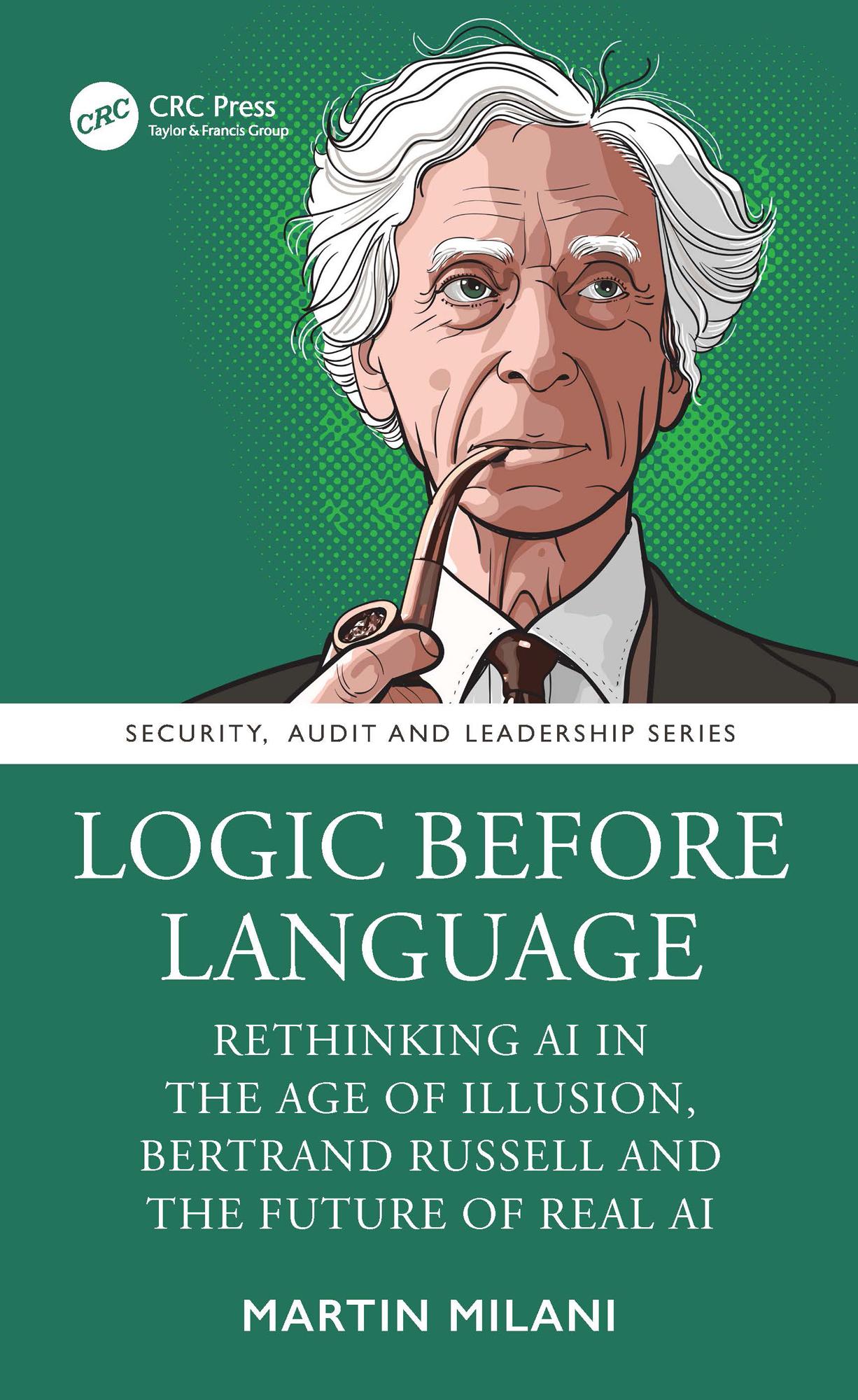
Fluency is not intelligence. Prediction is not understanding. And today’s AI has mistaken one for the other.
In an era dominated by language models that imitate thought without engaging in it, Logic Before Language makes a bold and urgent argument: if we want machines that truly understand, reason, and justify their conclusions, we must rebuild AI from its logical foundations.
Drawing from the intellectual lineage of Aristotle, Euclid, Russell, Gödel, Turing, McCarthy, and Minsky, Martin Milani exposes the core illusion beneath modern AI, the belief that eloquence and probability can substitute for meaning and reasoning. He shows how today’s systems generate speech without comprehension, confidence without justification, and predictions without any grounding in truth.
At the center of the book is Real-Time Reasoning (RTR), a new multi-layer architecture for AI that integrates perceptual learning with Bayesian inference, symbolic reasoning, fuzzy logic, logic-based explanation, and transparent decision pathways. RTR does not imitate intelligence; it constructs it. It reasons in real time, exposes every inference step, and produces conclusions that can be interrogated, audited, verified, and trusted.
This architecture is designed for epistemic integrity, with systems that not only produce outputs, but whose reasoning can be explained, justified, and challenged. It enables explainability and auditability by making knowledge dynamic, structured, traceable, and accountable, and it opens the door to a future of human–AI symbiosis, where machines serve as partners in reasoning rather than engines of imitation, and not as replacements for human judgment or creativity, but as collaborators in amplifying and extending both.
Bridging philosophy, mathematics, cognitive science, and computer science, Logic Before Language offers:
- A historical and epistemological critique of AI’s drift from logic to statistical mimicry.
- A reconstruction of intelligence grounded in causal reasoning, structure, and explanation.
- A practical, future-focused framework for building AI systems that reason deductively, inductively, and abductively, generating auditable and justified conclusions, meaningful explanations, and new knowledge.
- A roadmap for trustworthy, transparent, and symbiotic machine intelligence.
For technologists, researchers, academics, policymakers, philosophers, deep thinkers, and AI enthusiasts who sense that something fundamental is missing in today’s AI revolution, this book delivers both diagnosis and blueprint. It argues that the next era of AI will not be defined by bigger models or more data, but by a return to logic, meaning, and real understanding.
This is the case for AI that thinks and reasons. Not just one that talks.
Pay easily by card, Klarna, Apple Pay or Google Pay. Not happy? You always have a 14-day money-back guarantee. Read more in our terms. If you have any questions, email us at hello@memmo.org.
Memmo makes studying easier – wherever you are in the world. We bring your course books and smart study tools together in one place: summaries, quizzes, podcasts and flashcards. Plus Ted, your study buddy who answers anything you wonder. Over 50,000 students already study here – built to help you learn faster and stress less.