
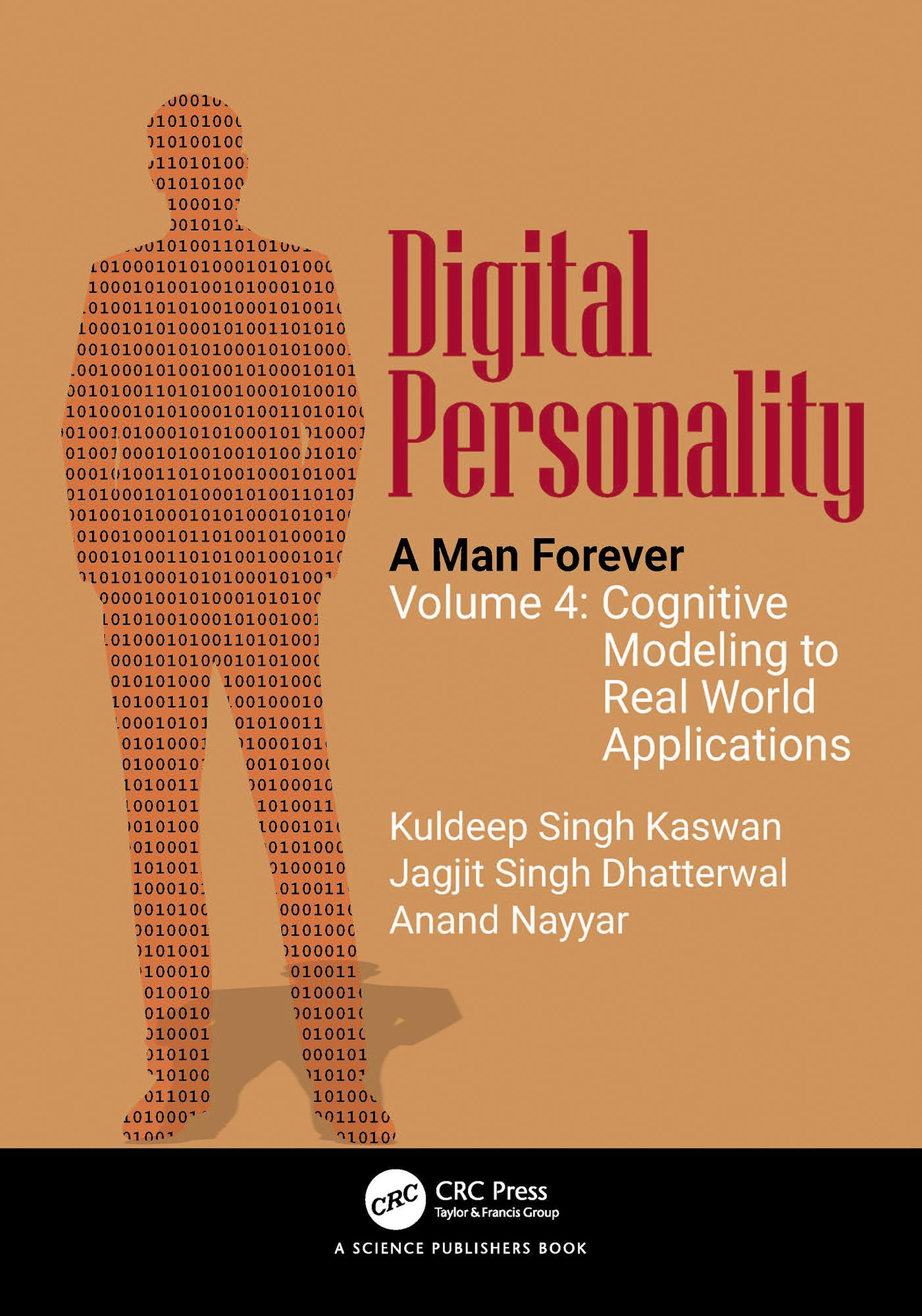
The book provides an overview of what it means to create personality-like, thinking, reasoning, deciding technologies. It reviews the development of cognitive modeling as theory based on the principles of psychology and neuroscience and as used in AI, ML, and human computer interaction. The chapters deal with topics like cognitive architectures, knowledge representation, natural language processing, and adaptive learning algorithms. It accentuates how digital personalities complement and amplify real-world application solutions that include a virtual assistant, social robot, autonomous systems, and decision-support systems. Includes several case studies and examples from actual lives wherein the authors demonstrate how prominent cognitive models become the leading ideas for developing health cares, educational projects and smart surroundings. It also discusses useful and interesting ethical and philosophical issues that relate to identity, existence of consciousness, and humans' interaction with AI. It examines the effect of having digital agents that imitate and emulate humans, as well as to some extent, control them.
The book will benefit students, scientists, technocrats, and the common man and unravels the missing link between human cognition and technology.
Key Features:
-Explains cognitive architectures, theories and examples, and how it can be applied to human beings and to the development of AI.
-Combines information from the sphere of neuroscience, psychology, AI, and ML, providing the reader with an extensive perception of the concept of a digital personality.
-Provides real-life examples of application in healthcare facilities, autonomous vehicles, buildings and homes, decision making, interactive systems and interactions.
-Examines trends of creating and using digital personalities introduced within new technologies such as Metaverse, IoT, Blockchain, Augmented Reality, and Cognitive IoT (CIoT).
-Comprises numerous case studies and examples to explain how cognitive models are used in effective working systems.
-Identifies important aspects that should be proactively addressed is the human-AI partnership.
-Explores how self-representations may enrich the communication between humans and computers thus optimizing the collaboration in different fields.
Pay easily by card, Klarna, Apple Pay or Google Pay. Not happy? You always have a 14-day money-back guarantee. Read more in our terms. If you have any questions, email us at hello@memmo.org.
Memmo makes studying easier – wherever you are in the world. We bring your course books and smart study tools together in one place: summaries, quizzes, podcasts and flashcards. Plus Ted, your study buddy who answers anything you wonder. Over 50,000 students already study here – built to help you learn faster and stress less.