
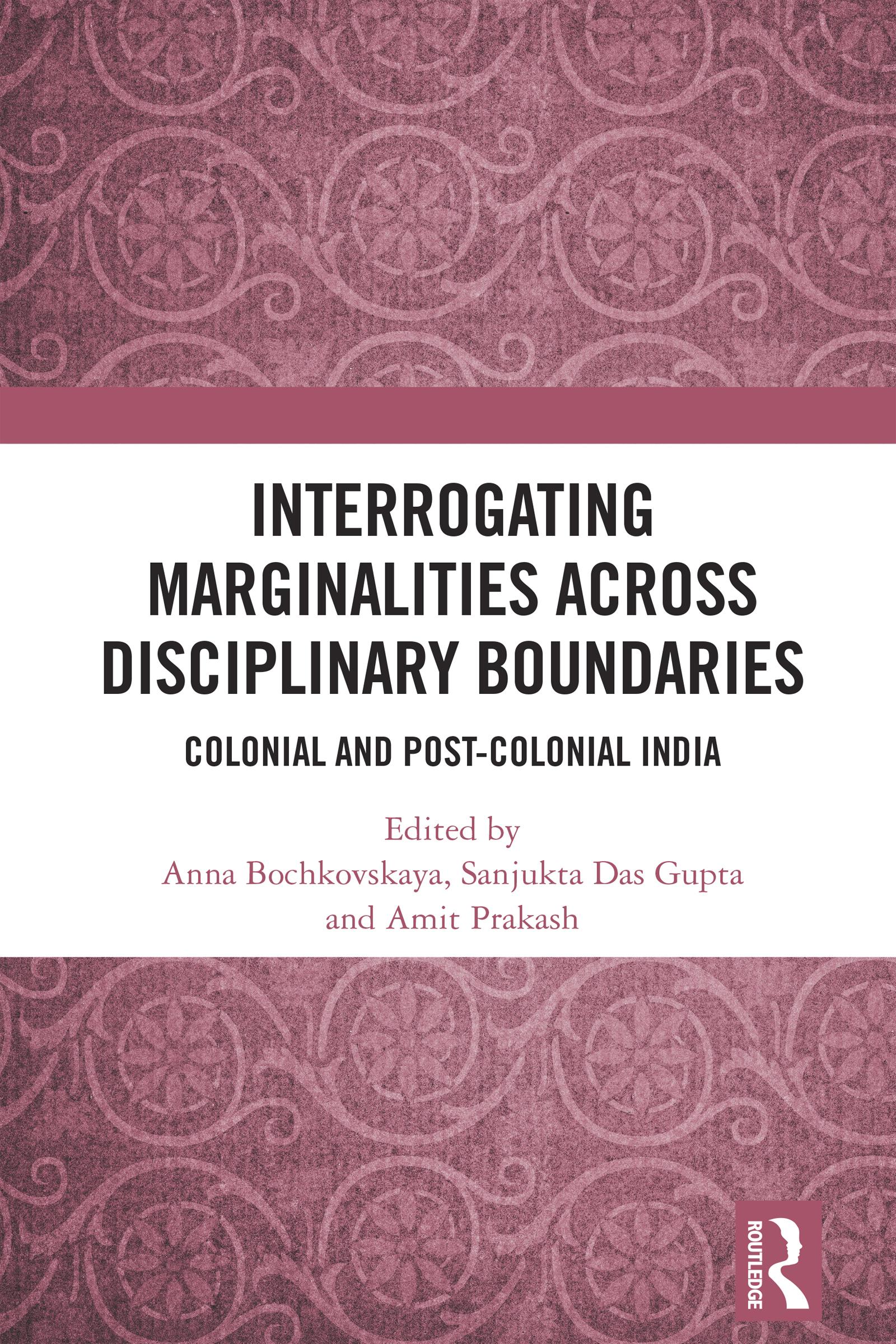
This volume adopts an interdisciplinary approach to rethink the multiple dimensions of marginality – political, societal, economic, cultural, legal and spatial. It explores their new representations in colonial and post-colonial India. Departing from extant analyses of experiences of marginalization in diverse social groups, it proposes to problematize the conceptualization of marginality, focusing on its evolution through space and time. A relational position, marginality, it is argued, presupposes a confrontation with centrality or the ‘mainstream’ within a common discourse of knowledge and power. The volume emphasizes that the process of marginalization is not a ‘marginal’ phenomenon and draws attention to the historical processes which determine, establish and perpetuate the margins.
The book reflects on varied aspects of evolving marginalities – structural, cultural and psychological – in South Asia in diverse temporal, spatial or societal contexts. It examines the discourses, institutional mechanisms and economic processes within which marginalities are located. This work will be an important read for scholars and researchers of history, anthropology, subaltern studies, exclusion studies, South Asian history, post-colonial studies, political studies, Indian history, cultural studies and history, in general.
Pay easily by card, Klarna, Apple Pay or Google Pay. Not happy? You always have a 14-day money-back guarantee. Read more in our terms. If you have any questions, email us at hello@memmo.org.
Memmo makes studying easier – wherever you are in the world. We bring your course books and smart study tools together in one place: summaries, quizzes, podcasts and flashcards. Plus Ted, your study buddy who answers anything you wonder. Over 50,000 students already study here – built to help you learn faster and stress less.