
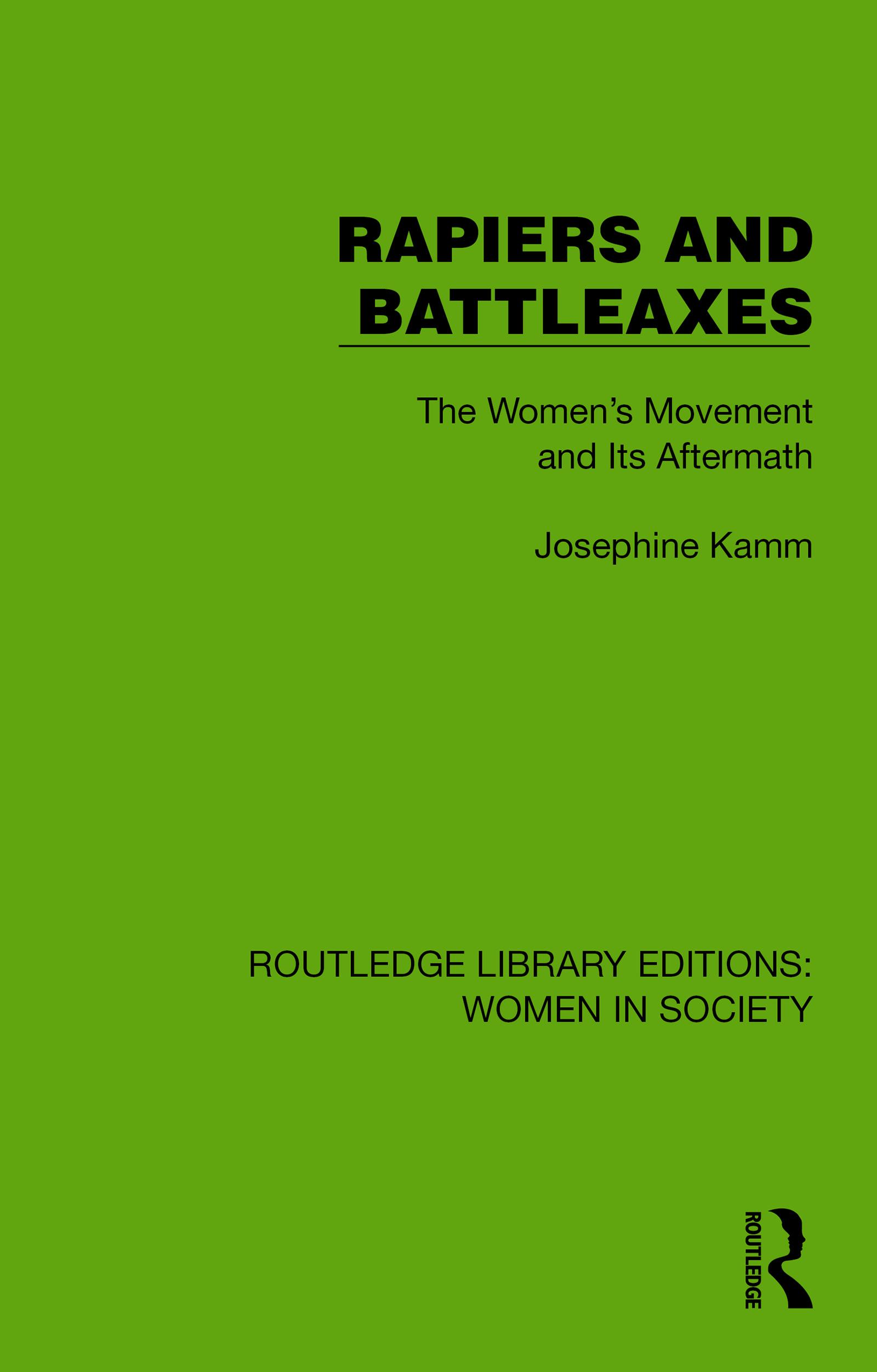
The long and bitter struggle for the vote is certainly the most spectacular part of the history of women’s emancipation. Originally published in 1966 Rapiers and Battleaxes tells the story in its wider aspect and in terms of the pioneers in the various fields.
Just a hundred years previously – in 1866 – the first women’s suffrage committee was formed in London with the object of collecting signatures to petition for the enfranchisement of women which John Stuart Mill, MP for Westminster, had undertaken to present in Parliament. Prominent among the committee members were Barbara Bodichon, who had been active ten years earlier in the agitation for the Married Women’s Property Bill; Emily Davies, pioneer of higher education for women; and Elizabeth Garrett, who was the first woman to obtain a medical training in this country. Among the pioneers also are Mary Wollstonecraft, whose book A Vindication of the Rights of Woman sparked off the women’s movement; the philanthropist Angela Burdett-Coutts; the social reformers Mary Carpenter, Louisa Twining and Octavia Hill; Emma Paterson and her work for women’s trade unions; Sophia Jex-Blake, who forced an entry for women into the medical profession; and Josephine Butler and her courageous campaign for the repeal of the Contagious Diseases Acts. In the political field, of course, are Emmeline Pankhurst and her followers; and also Millicent Fawcett, Elizabeth Garrett’s younger sister, the statesmanlike leader of the constitutional suffragists, and Eleanor Rathbone, MP, her successor in the campaign for equal rights.
The story is brought up to date with the work of other women in Parliament and the appointment in 1965 of the first woman High Court Judge. And it points to the outstanding problem at the time, which was not so much lack of equal pay – although this still existed, particularly in trade and industry – but of equal opportunity. Subjects still being fought today, this reissue can be read in its historical context.
Pay easily by card, Klarna, Apple Pay or Google Pay. Not happy? You always have a 14-day money-back guarantee. Read more in our terms. If you have any questions, email us at hello@memmo.org.
Memmo makes studying easier – wherever you are in the world. We bring your course books and smart study tools together in one place: summaries, quizzes, podcasts and flashcards. Plus Ted, your study buddy who answers anything you wonder. Over 50,000 students already study here – built to help you learn faster and stress less.