
“Our community has continued to grow exponentially, thanks to those who inspire the next generation. And inspiring the next generation is what the authors of Analyzing Baseball Data with R are doing. They are setting the career path for still thousands more. We all need some sort of kickstart to take that first or second step. You may be a beginner R coder, but you need access to baseball data. How do you access this data, how do you manipulate it, how do you analyze it? This is what this book does for you. But it does more, by doing what sabermetrics does best: it asks baseball questions. Throughout the book, baseball questions are asked, some straightforward, and others more thought-provoking.”
From the Foreword by Tom Tango
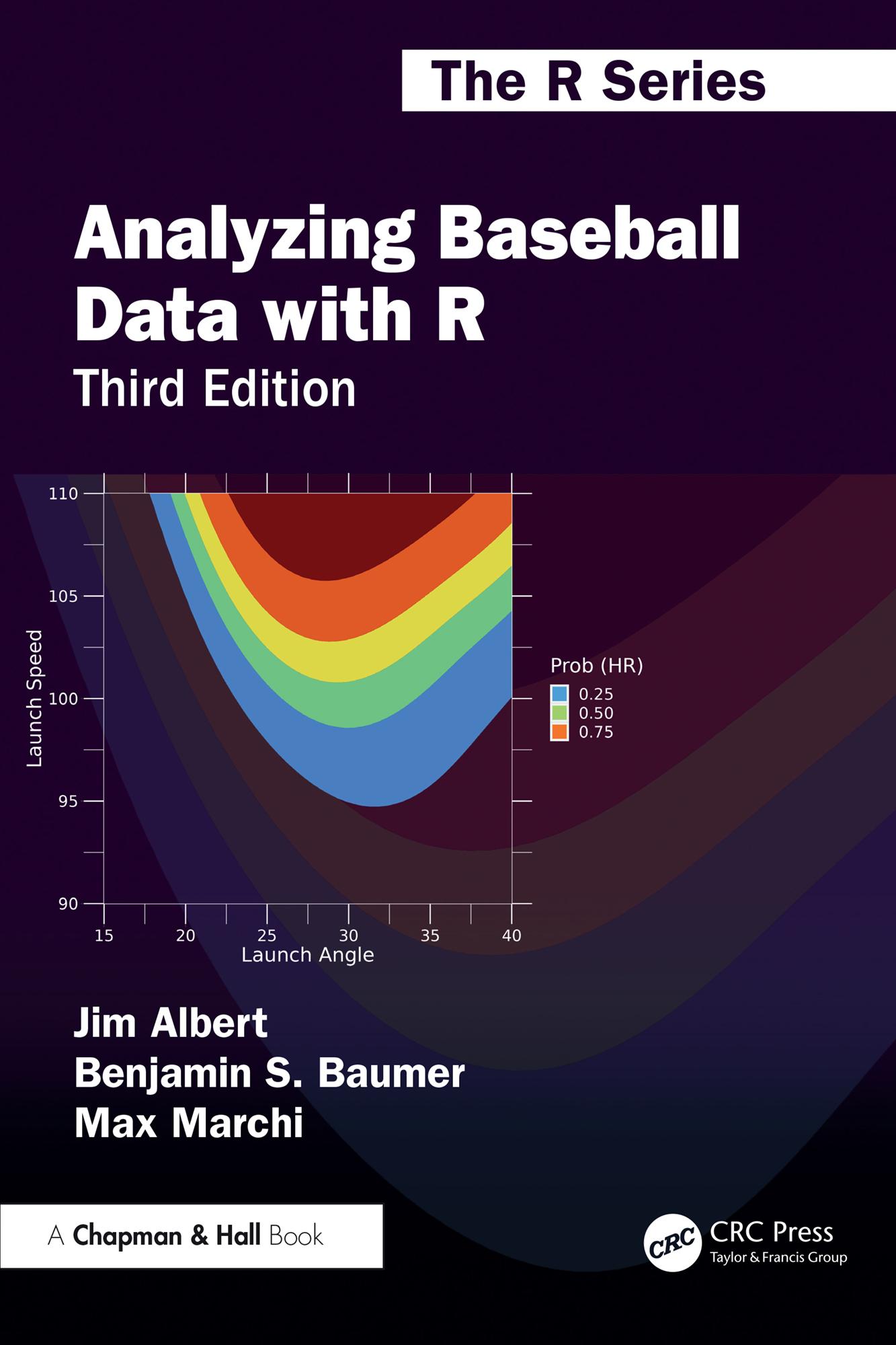
Analyzing Baseball Data with R Third Edition introduces R to sabermetricians, baseball enthusiasts, and students interested in exploring the richness of baseball data. It equips you with the necessary skills and software tools to perform all the analysis steps, from importing the data to transforming them into an appropriate format to visualizing the data via graphs to performing a statistical analysis.
The authors first present an overview of publicly available baseball datasets and a gentle introduction to the type of data structures and exploratory and data management capabilities of R. They also cover the ggplot2 graphics functions and employ a tidyverse-friendly workflow throughout. Much of the book illustrates the use of R through popular sabermetrics topics, including the Pythagorean formula, runs expectancy, catcher framing, career trajectories, simulation of games and seasons, patterns of streaky behavior of players, and launch angles and exit velocities. All the datasets and R code used in the text are available for download online.
New to the third edition is the revised R code to make use of new functions made available through the tidyverse. The third edition introduces three chapters of new material, focusing on communicating results via presentations using the Quarto publishing system, web applications using the Shiny package, and working with large data files. An online version of this book is hosted at https://beanumber.github.io/abdwr3e/.
Pay easily by card, Klarna, Apple Pay or Google Pay. Not happy? You always have a 14-day money-back guarantee. Read more in our terms. If you have any questions, email us at hello@memmo.org.
Memmo makes studying easier – wherever you are in the world. We bring your course books and smart study tools together in one place: summaries, quizzes, podcasts and flashcards. Plus Ted, your study buddy who answers anything you wonder. Over 50,000 students already study here – built to help you learn faster and stress less.