
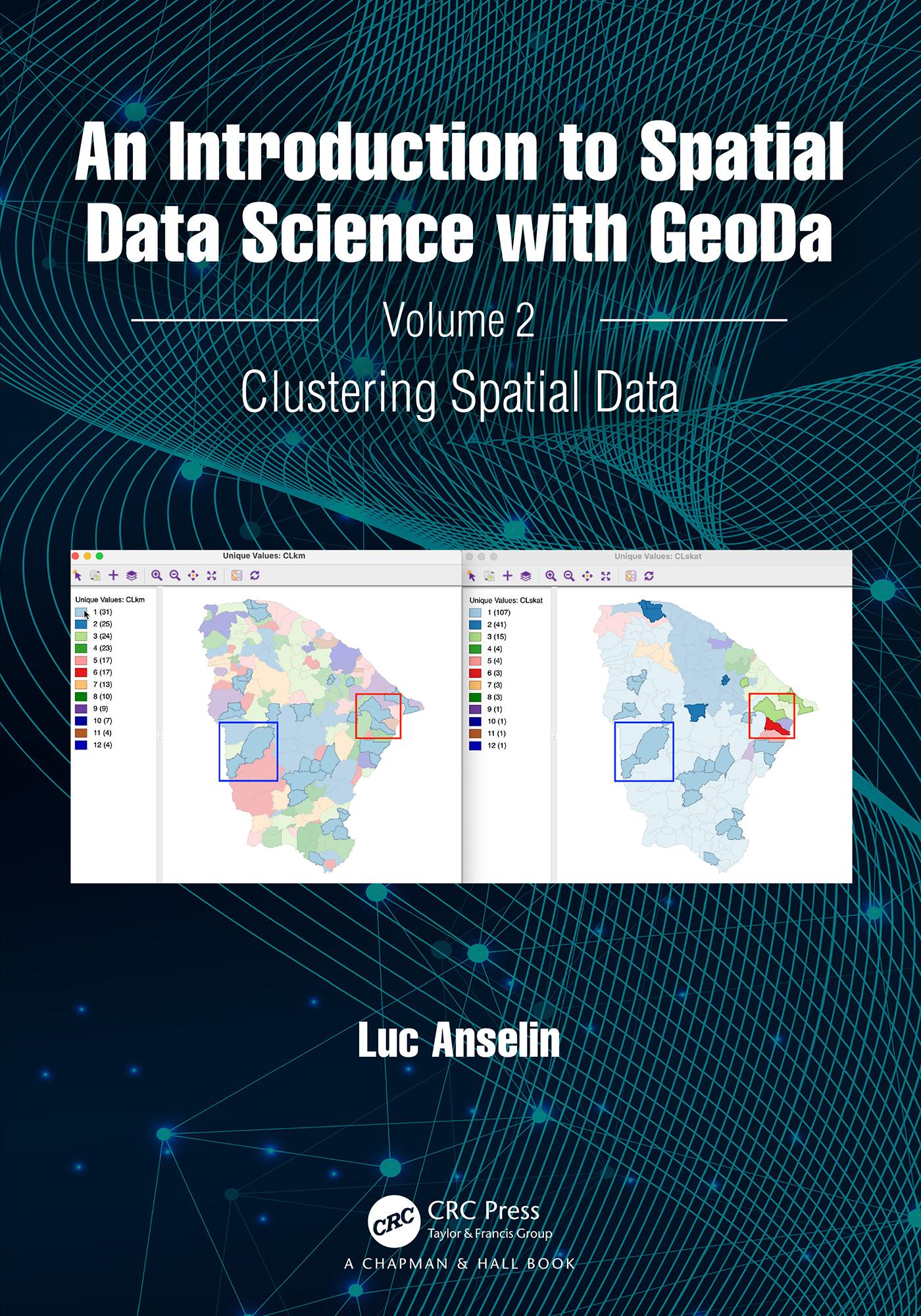
This book is the second in a two-volume series that introduces the field of spatial data science. It moves beyond pure data exploration to the organization of observations into meaningful groups, i.e., spatial clustering. This constitutes an important component of so-called unsupervised learning, a major aspect of modern machine learning.
The distinctive aspects of the book are both to explore ways to spatialize classic clustering methods through linked maps and graphs, as well as the explicit introduction of spatial contiguity constraints into clustering algorithms. Leveraging a large number of real-world empirical illustrations, readers will gain an understanding of the main concepts and techniques and their relative advantages and disadvantages. The book also constitutes the definitive user’s guide for these methods as implemented in the GeoDa open source software for spatial analysis.
It is organized into three major parts, dealing with dimension reduction (principal components, multidimensional scaling, stochastic network embedding), classic clustering methods (hierarchical clustering, k-means, k-medians, k-medoids and spectral clustering), and spatially constrained clustering methods (both hierarchical and partitioning). It closes with an assessment of spatial and non-spatial cluster properties.
The book is intended for readers interested in going beyond simple mapping of geographical data to gain insight into interesting patterns as expressed in spatial clusters of observations. Familiarity with the material in Volume 1 is assumed, especially the analysis of local spatial autocorrelation and the full range of visualization methods.
Pay easily by card, Klarna, Apple Pay or Google Pay. Not happy? You always have a 14-day money-back guarantee. Read more in our terms. If you have any questions, email us at hello@memmo.org.
Memmo makes studying easier – wherever you are in the world. We bring your course books and smart study tools together in one place: summaries, quizzes, podcasts and flashcards. Plus Ted, your study buddy who answers anything you wonder. Over 50,000 students already study here – built to help you learn faster and stress less.