
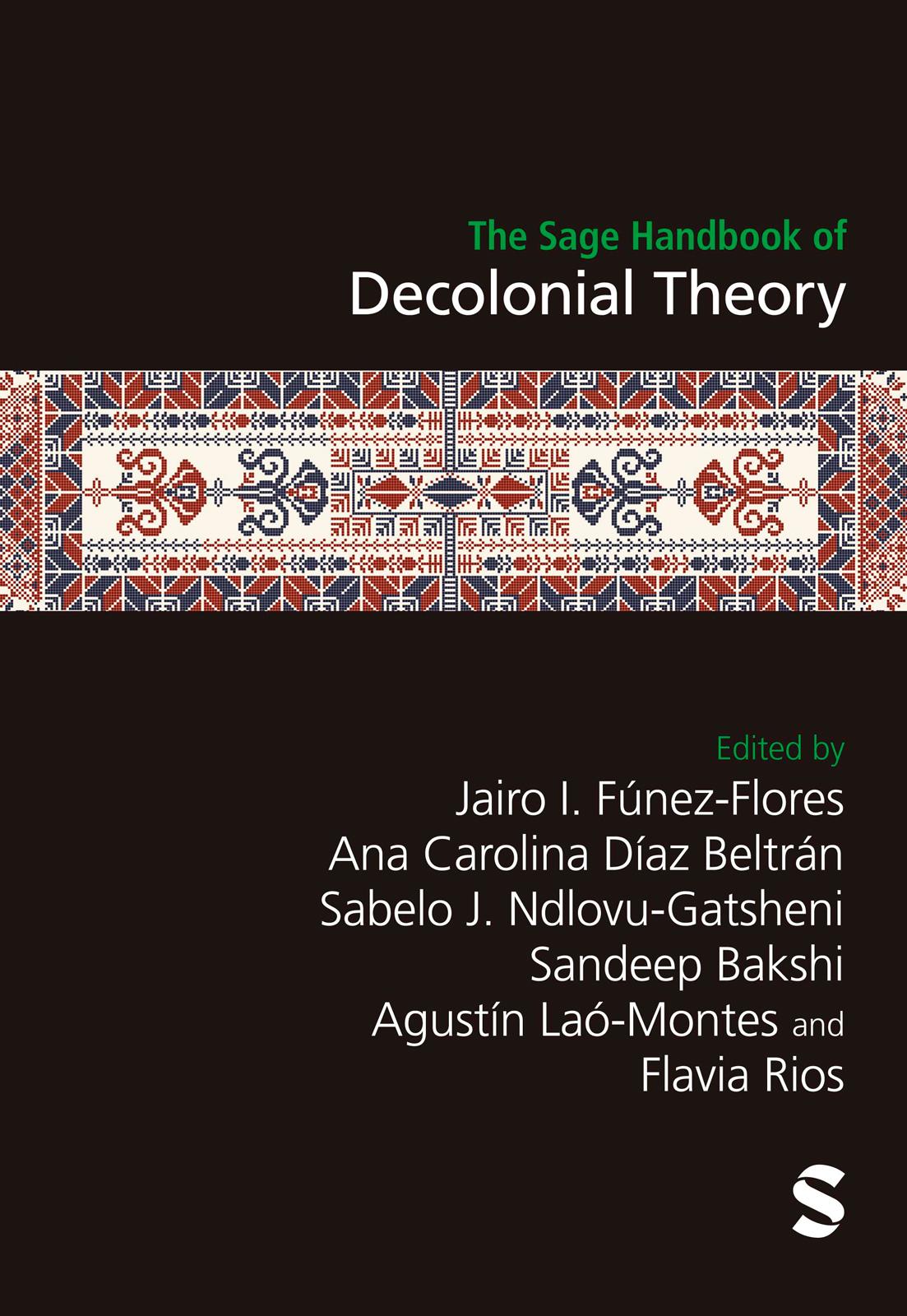
The Sage Handbook of Decolonial Theory is a groundbreaking transdisciplinary resource that expands the epistemological and geographical horizons of decolonial thought. This handbook prioritizes the Global South, fostering South-North and South-South inter-epistemic dialogues and situating decolonial thought in sites of struggle. It builds on decolonial thought and praxis from Latin America and the Caribbean, Africa, Asia, and Palestine, among other regions and countries. Addressing the erasure of knowledge production from the Global South in dominant academic spaces, this handbook brings together decolonial scholars and activist intellectuals from the Global South and engages with politically committed scholars in the Global North. It emphasizes the geopolitics and ethics of knowledge production and the importance of situating one’s work in historically excluded regions and communities.
Organized into five parts, the handbook includes conceptual essays and empirical studies on decolonial thought and praxis. It covers a range of topics from (de)coloniality, geopolitics, and transdisciplinarity to decolonial feminisms, gender and sexuality studies, and racial capitalism. The chapters convey a sense of urgency and a committed political voice, demonstrating how decolonial theory can interrogate and intervene in the modern/colonial racial capitalist heteropatriarchal world.
The Sage Handbook of Decolonial Theory is not just for academics; it is written for anyone interested in radical thought and praxis. It recognizes decolonial theory as a plural and dynamic field, concerned with power hierarchies, historiography, and epistemological critiques of Eurocentrism. Ultimately, it teaches us how to think with and act alongside struggles for liberation.
Part I: Key Debates in Decolonial Theory
Part II: Geopolitics and Geographies
Part III: Transdisciplinarity
Part IV: Feminisms, Genders, & Sexualities
Part V: Racial Capitalism
Pay easily by card, Klarna, Apple Pay or Google Pay. Not happy? You always have a 14-day money-back guarantee. Read more in our terms. If you have any questions, email us at hello@memmo.org.
Memmo makes studying easier – wherever you are in the world. We bring your course books and smart study tools together in one place: summaries, quizzes, podcasts and flashcards. Plus Ted, your study buddy who answers anything you wonder. Over 50,000 students already study here – built to help you learn faster and stress less.