
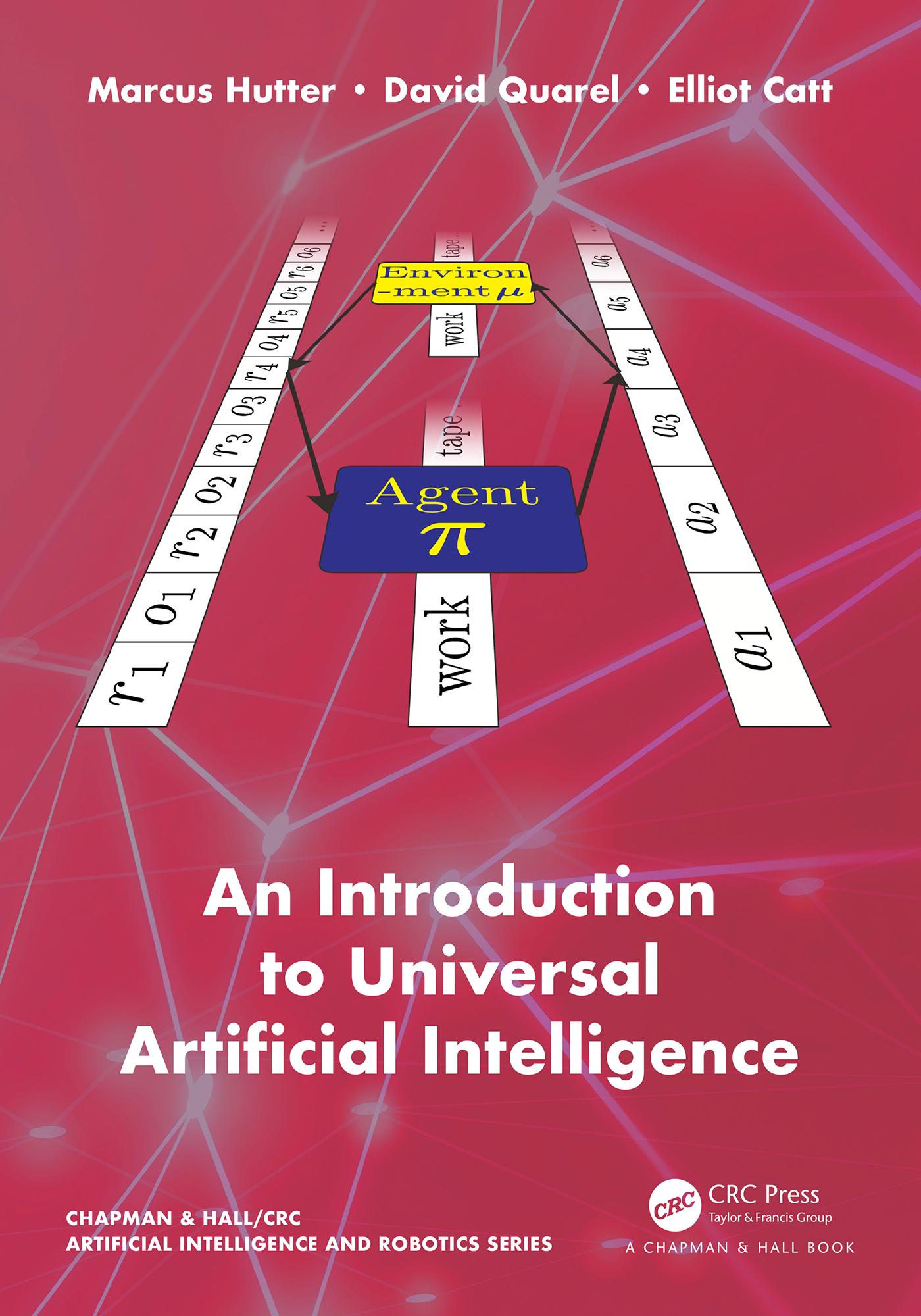
An Introduction to Universal Artificial Intelligence provides the formal underpinning of what it means for an agent to act intelligently in an unknown environment. First presented in Universal Algorithmic Intelligence (Hutter, 2000), UAI offers a framework in which virtually all AI problems can be formulated, and a theory of how to solve them. UAI unifies ideas from sequential decision theory, Bayesian inference, and algorithmic information theory to construct AIXI, an optimal reinforcement learning agent that learns to act optimally in unknown environments. AIXI is the theoretical gold standard for intelligent behavior.
The book covers both the theoretical and practical aspects of UAI. Bayesian updating can be done efficiently with context tree weighting, and planning can be approximated by sampling with Monte Carlo tree search. It provides algorithms for the reader to implement, and experimental results to compare against. These algorithms are used to approximate AIXI. The book ends with a philosophical discussion of Artificial General Intelligence: Can super-intelligent agents even be constructed? Is it inevitable that they will be constructed, and what are the potential consequences?
This text is suitable for late undergraduate students. It provides an extensive chapter to fill in the required mathematics, probability, information, and computability theory background. You can also visit the author website: http://www.hutter1.net/ai/uaibook2.htm.
Pay easily by card, Klarna, Apple Pay or Google Pay. Not happy? You always have a 14-day money-back guarantee. Read more in our terms. If you have any questions, email us at hello@memmo.org.
Memmo makes studying easier – wherever you are in the world. We bring your course books and smart study tools together in one place: summaries, quizzes, podcasts and flashcards. Plus Ted, your study buddy who answers anything you wonder. Over 50,000 students already study here – built to help you learn faster and stress less.