
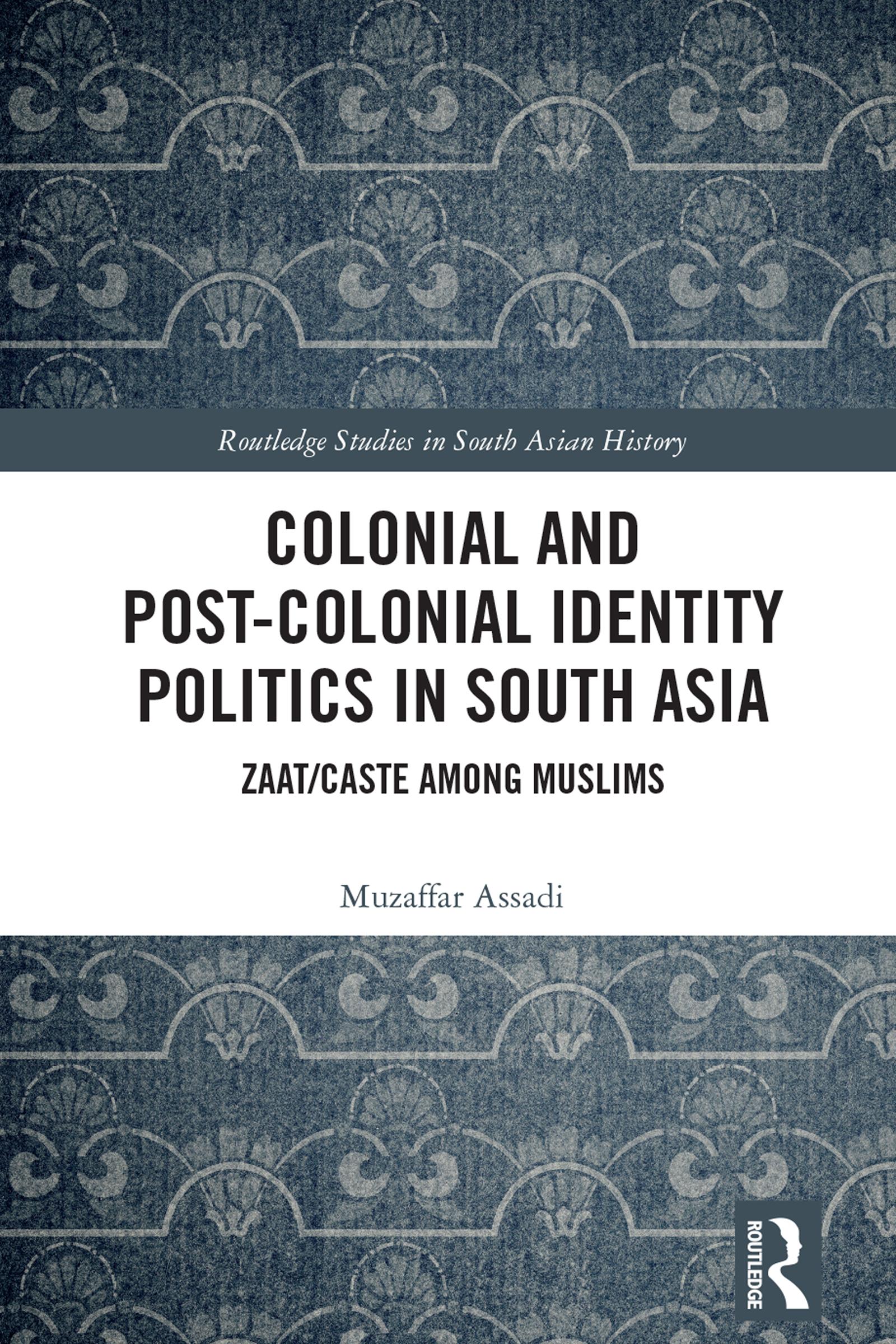
Colonial and Post-Colonial Identity Politics in South Asia analyses the colonial and post-colonial documentation and caste classification among Muslims in India, demonstrating that religion negotiated with regional social customs and local social practices while at the same time fostering a shared religious belief.
The central question addressed in this book is how different castes assert their identity for classification and how castes encountered colonial documentation. Identifying the colonial context of the documentation of castes among Muslims, and relying on colonial documentation in various census reports, gazetteers, government or police records, ethnographic studies, and travelogues, the author demonstrates the sheer diversity of attempts and castes among Muslims. The book deconstructs how under Colonialism Muslims were categorised into three broad but overlapping categories – Ashraf, Ajlafs, and Arzals – and that Muslims were categorised into Asiatic, Non-Asiatic, Foreign, Mixed, and Hindustani – Muslim categories. It argues that few colonial theories applied to Muslims. Finally, the author explores post-colonial documentation of castes among Muslims in various Commission reports, particularly in Backward class commission reports and its interplay in the reservation politics of the contemporary period and examines the growth of various Muslim caste organisations in different parts of India and their role in identity politics.
Providing a new perspective on the issue of minorities in India, this book will be of interest to scholars of religion, Islam, history, politics, and sociology of India.
Pay easily by card, Klarna, Apple Pay or Google Pay. Not happy? You always have a 14-day money-back guarantee. Read more in our terms. If you have any questions, email us at hello@memmo.org.
Memmo makes studying easier – wherever you are in the world. We bring your course books and smart study tools together in one place: summaries, quizzes, podcasts and flashcards. Plus Ted, your study buddy who answers anything you wonder. Over 50,000 students already study here – built to help you learn faster and stress less.