
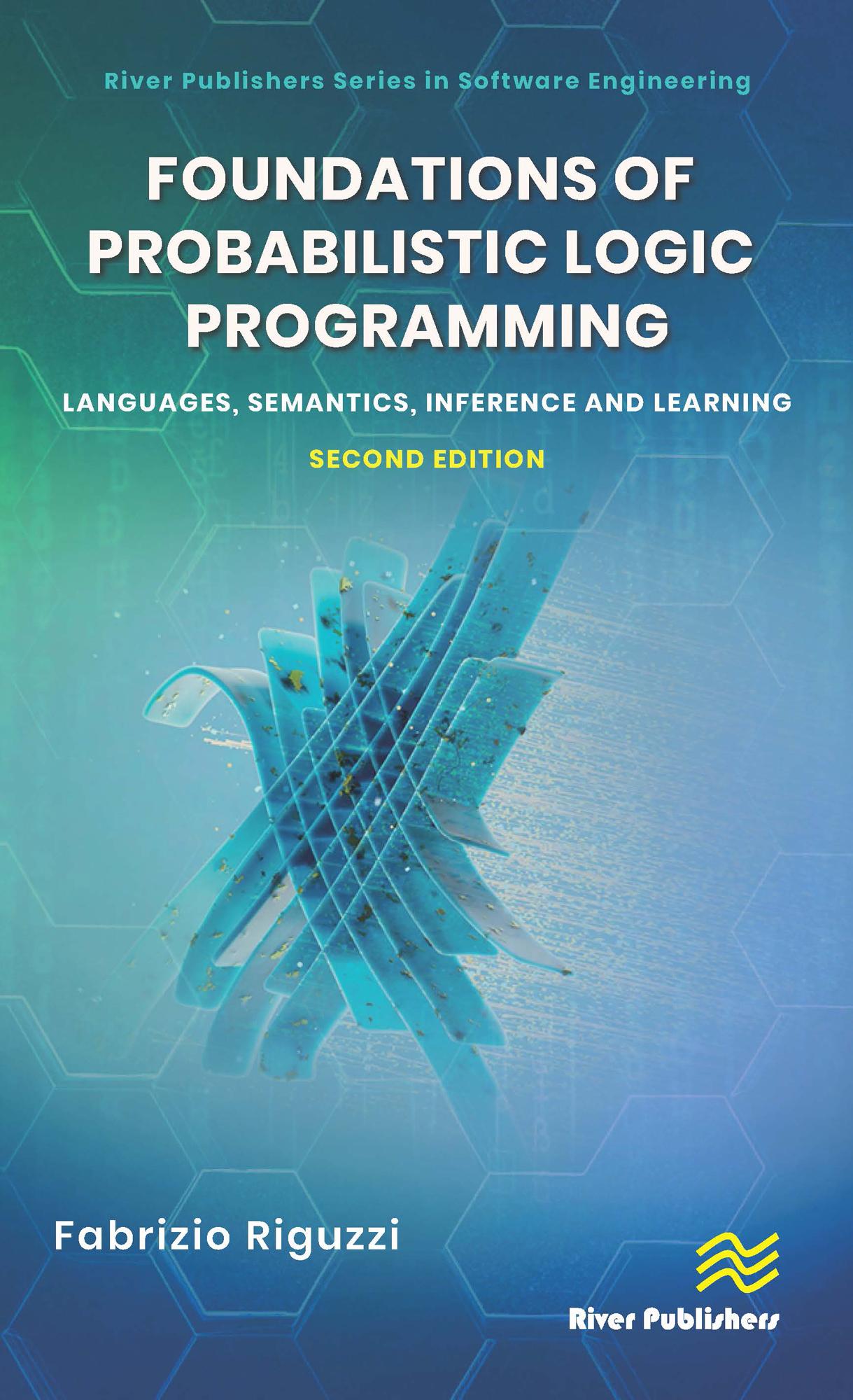
Since its birth, the field of Probabilistic Logic Programming has seen a steady increase of activity, with many proposals for languages and algorithms for inference and learning.
This book aims at providing an overview of the field with a special emphasis on languages under the Distribution Semantics, one of the most influential approaches. The book presents the main ideas for semantics, inference, and learning and highlights connections between the methods.
Many examples of the book include a link to a page of the web application http://cplint.eu where the code can be run online.
This 2nd edition aims at reporting the most exciting novelties in the field since the publication of the 1st edition. The semantics for hybrid programs with function symbols was placed on a sound footing. Probabilistic Answer Set Programming gained a lot of interest together with the studies on the complexity of inference. Algorithms for solving the MPE and MAP tasks are now available. Inference for hybrid programs has changed dramatically with the introduction of Weighted Model Integration.
With respect to learning, the first approaches for neuro-symbolic integration have appeared together with algorithms for learning the structure for hybrid programs.
Moreover, given the cost of learning PLPs, various works proposed language restrictions to speed up learning and improve its scaling.
Pay easily by card, Klarna, Apple Pay or Google Pay. Not happy? You always have a 14-day money-back guarantee. Read more in our terms. If you have any questions, email us at hello@memmo.org.
Memmo makes studying easier – wherever you are in the world. We bring your course books and smart study tools together in one place: summaries, quizzes, podcasts and flashcards. Plus Ted, your study buddy who answers anything you wonder. Over 50,000 students already study here – built to help you learn faster and stress less.