
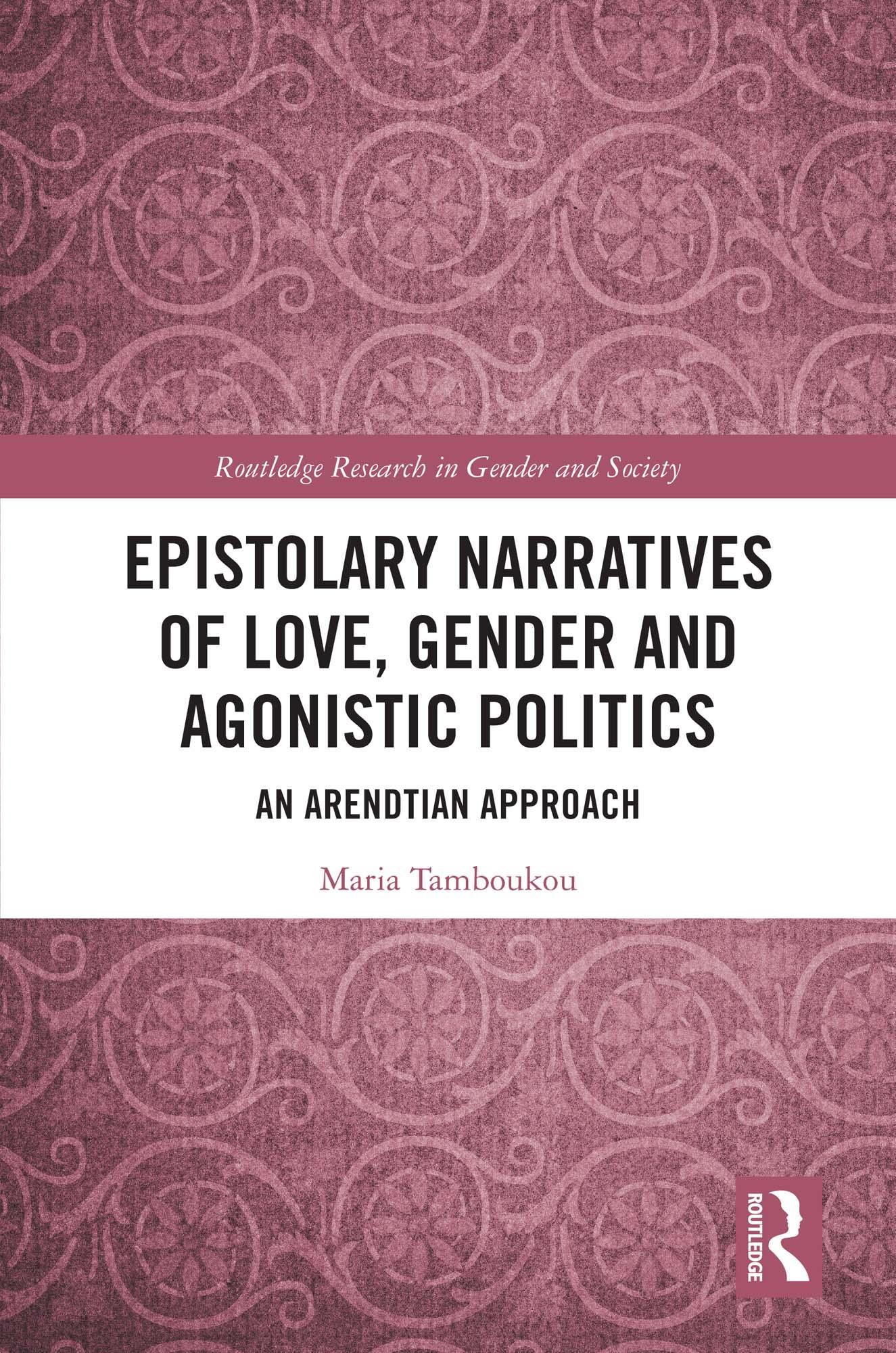
This book revolves around epistolary narratives of women political theorists and activists, following traces of Hannah Arendt’s philosophical approaches to love and agonistic politics. Arend’s interlocutors are four revolutionary women in the long durée of the nineteenth and twentieth centuries in Europe and the USA: the romantic socialist Désirée Véret-Gay, the Marxist Rosa Luxemburg, the anarchist Emma Goldman and the labour activist Rose Pesotta. The book’s central argument is that Arendt’s philosophical thought can throw light on dangerous liaisons between love, gender and agonistic politics, further making connections with feminist ruminations around love as an existential force in the ephemeral constitution of the female self in modernity. Drawing on extended research with physical, digital and published archival collections, the book responds to the challenges of ‘the digital turn’ and highlights the importance of memory work, as a way of understanding the lasting effects of the past on the present. As such, Epistolary Narratives of Love, Gender and Agonistic Politics will appeal to scholars of sociology and gender studies with interests in research methods—particularly archival methods—the work of Arendt, feminist thought and memory studies.
Pay easily by card, Klarna, Apple Pay or Google Pay. Not happy? You always have a 14-day money-back guarantee. Read more in our terms. If you have any questions, email us at hello@memmo.org.
Memmo makes studying easier – wherever you are in the world. We bring your course books and smart study tools together in one place: summaries, quizzes, podcasts and flashcards. Plus Ted, your study buddy who answers anything you wonder. Over 50,000 students already study here – built to help you learn faster and stress less.