
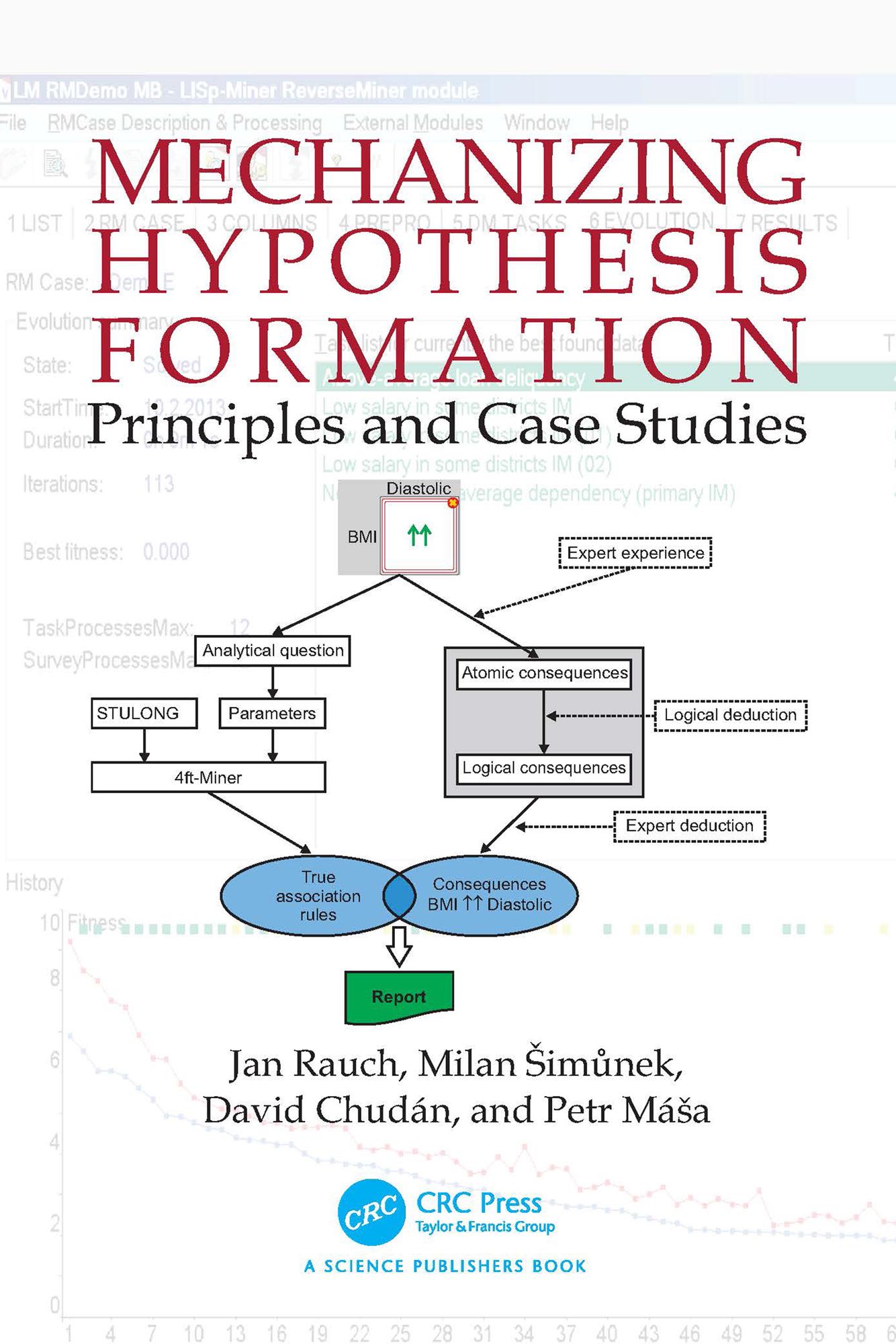
Mechanizing hypothesis formation is an approach to exploratory data analysis. Its development started in the 1960s inspired by the question “can computers formulate and verify scientific hypotheses?”. The development resulted in a general theory of logic of discovery. It comprises theoretical calculi dealing with theoretical statements as well as observational calculi dealing with observational statements concerning finite results of observation. Both calculi are related through statistical hypotheses tests. A GUHA method is a tool of the logic of discovery. It uses a one-to-one relation between theoretical and observational statements to get all interesting theoretical statements. A GUHA procedure generates all interesting observational statements and verifies them in a given observational data. Output of the procedure consists of all observational statements true in the given data. Several GUHA procedures dealing with association rules, couples of association rules, action rules, histograms, couples of histograms, and patterns based on general contingency tables are involved in the LISp-Miner system developed at the Prague University of Economics and Business. Various results about observational calculi were achieved and applied together with the LISp-Miner system.
The book covers a brief overview of logic of discovery. Many examples of applications of the GUHA procedures to solve real problems relevant to data mining and business intelligence are presented. An overview of recent research results relevant to dealing with domain knowledge in data mining and its automation is provided. Firsthand experiences with implementation of the GUHA method in the Python language are presented.
Pay easily by card, Klarna, Apple Pay or Google Pay. Not happy? You always have a 14-day money-back guarantee. Read more in our terms. If you have any questions, email us at hello@memmo.org.
Memmo makes studying easier – wherever you are in the world. We bring your course books and smart study tools together in one place: summaries, quizzes, podcasts and flashcards. Plus Ted, your study buddy who answers anything you wonder. Over 50,000 students already study here – built to help you learn faster and stress less.