
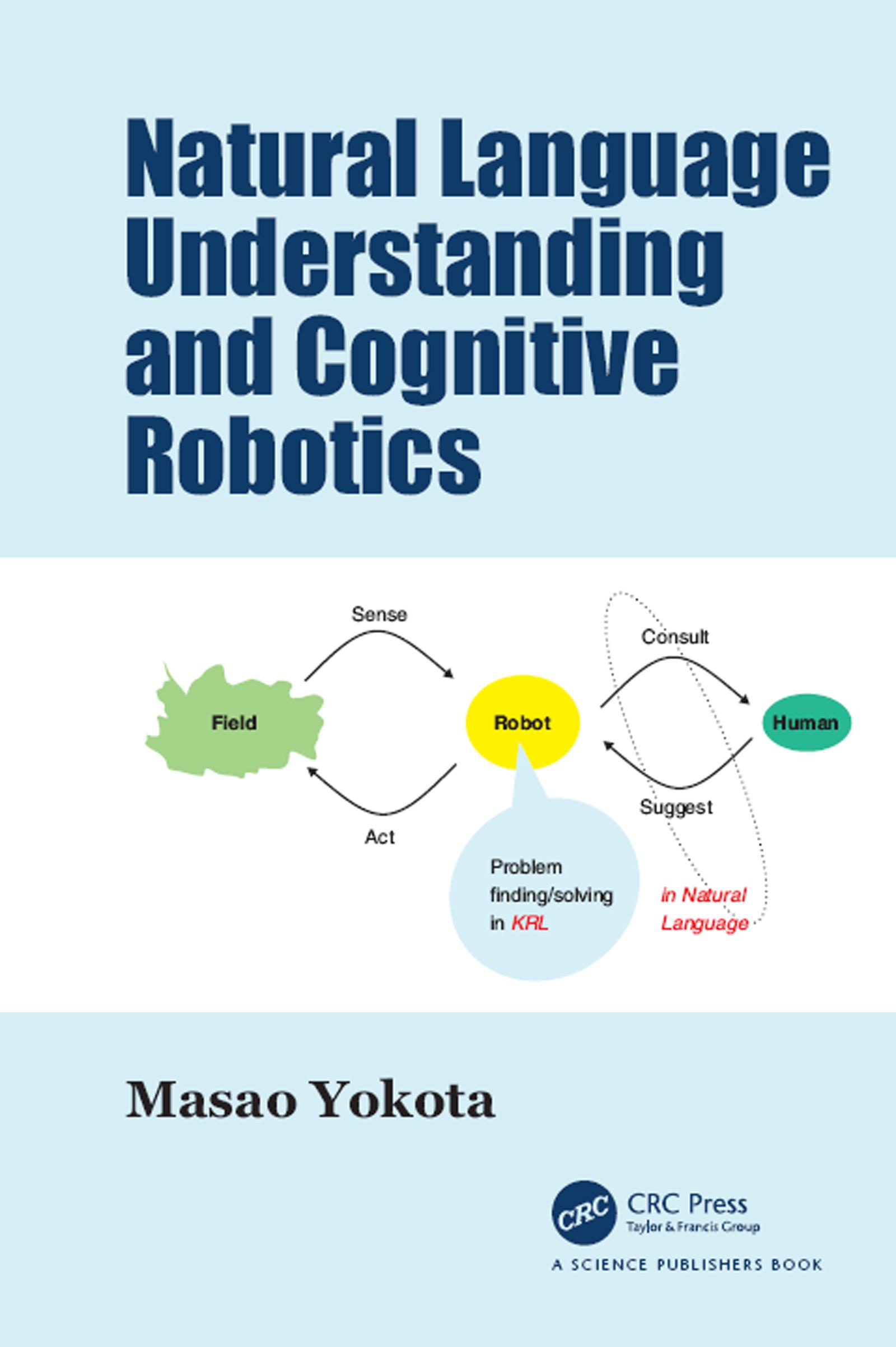
In the not so distant future, we can expect a world where humans and robots coexist and interact with each other. For this to occur, we need to understand human traits, such as seeing, hearing, thinking, speaking, etc., and institute these traits in robots. The most essential feature necessary for robots to achieve is that of integrative multimedia understanding (IMU) which occurs naturally in humans. It allows us to assimilate pieces of information expressed through different modes such as speech, pictures, gestures, etc.
The book describes how robots acquire traits like natural language understanding (NLU) as the central part of IMU. Mental image directed semantic theory (MIDST) is its core, and is based on the hypothesis that NLU is essentially the processing of mental image associated with natural language expressions, namely, mental-image based understanding (MBU). MIDST is intended to model omnisensory mental image in human and to afford a knowledge representation system in order for integrative management of knowledge subjective to cognitive mechanisms of intelligent entities such as humans and robots based on a mental image model visualized as ‘Loci in Attribute Spaces’ and its description language Lmd (mental image description language) to be employed for predicate logic with a systematic scheme for symbol-grounding. This language works as an interlingua among various kinds of information media, and has been applied to several versions of the intelligent system interlingual understanding model aiming at general system (IMAGES). Its latest version, i.e. conversation management system (CMS) simulates MBU and comprehends the user’s intention through dialogue to find and solve problems, and finally, provides a response in text or animation.
The book is aimed at researchers and students interested in artificial intelligence, robotics, and cognitive science. Based on philosophical considerations, the methodology will also have an appeal in linguistics, psychology, ontology, geography, and cartography.
Key Features:
- Describes the methodology to provide robots with human-like capability of natural language understanding (NLU) as the central part of IMU
- Uses methodology that also relates to linguistics, psychology, ontology, geography, and cartography
- Examines current trends in machine translation
Pay easily by card, Klarna, Apple Pay or Google Pay. Not happy? You always have a 14-day money-back guarantee. Read more in our terms. If you have any questions, email us at hello@memmo.org.
Memmo makes studying easier – wherever you are in the world. We bring your course books and smart study tools together in one place: summaries, quizzes, podcasts and flashcards. Plus Ted, your study buddy who answers anything you wonder. Over 50,000 students already study here – built to help you learn faster and stress less.