
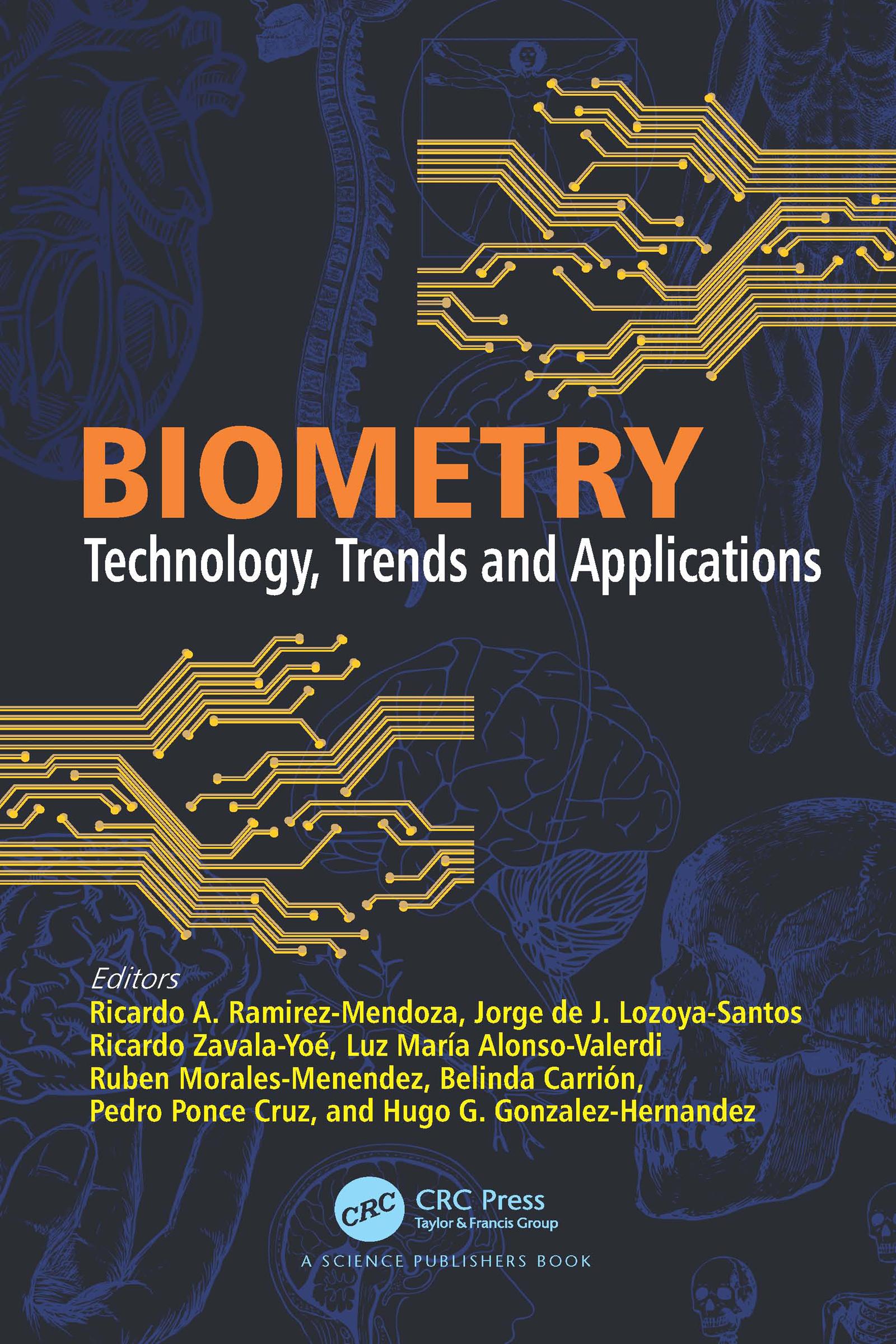
Biometrics provide quantitative representations of human features, physiological and behavioral. This book is a compilation of biometric technologies developed by various research groups in Tecnologico de Monterrey, Mexico. It provides a summary of biometric systems as a whole, explaining the principles behind physiological and behavioral biometrics and exploring different types of commercial and experimental technologies and current and future applications in the fields of security, military, criminology, healthcare education, business, and marketing.
Examples of biometric systems using brain signals or electroencephalography (EEG) are given. Mobile and home EEG use in children’s natural environments is covered. At the same time, some examples focus on the relevance of such technology in monitoring epileptic encephalopathies in children.
Using reliable physiological signal acquisition techniques, functional Human Machine Interfaces (HMI) and Brain-Computer Interfaces (BCI) become possible. This is the case of an HMI used for assistive navigation systems, controlled via voice commands, head, and eye movements. A detailed description of the BCI framework is presented, and applications of user-centered BCIs, oriented towards rehabilitation, human performance, and treatment monitoring are explored.
Massive data acquisition also plays an essential role in the evolution of biometric systems. Machine learning, deep learning, and Artificial Intelligence (AI) are crucial allies here. They allow the construction of models that can aid in early diagnosis, seizure detection, and data-centered medical decisions. Such techniques will eventually lead to a more concise understanding of humans.
Pay easily by card, Klarna, Apple Pay or Google Pay. Not happy? You always have a 14-day money-back guarantee. Read more in our terms. If you have any questions, email us at hello@memmo.org.
Memmo makes studying easier – wherever you are in the world. We bring your course books and smart study tools together in one place: summaries, quizzes, podcasts and flashcards. Plus Ted, your study buddy who answers anything you wonder. Over 50,000 students already study here – built to help you learn faster and stress less.