
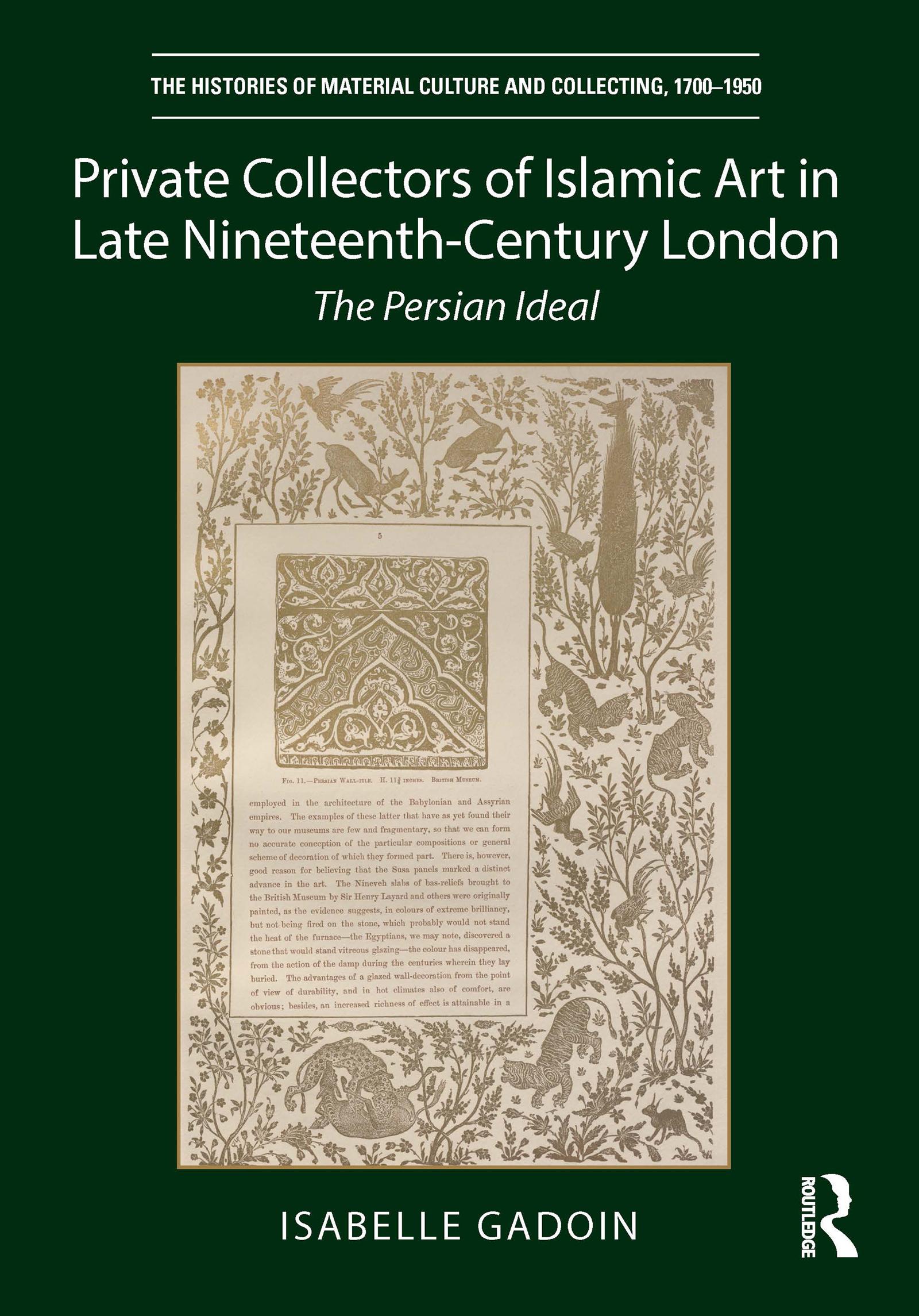
This book examines British collectors of so-called Persian art (a broad umbrella term then covering a large portion of Islamic art) in the late 19th century, including ceramics, metalwork, carpets, textiles and woodwork.
Based on a foundational event, the very first exhibition of “Persian and Arab Art” held by a London Gentlemen’s Club in 1885, this book follows one generation of men, retracing the subtle shades of difference among “amateurs,” “connoisseurs,” “experts” and “collectors,” and exploring all the mechanisms of the construction of a collective fascination for the Orient. Isabelle Gadoin uncovers some of the first “scientific” analyses of Islamic objects and of the first private notebooks or exhibition catalogues, to provide an in-depth study of the way Westerners talked about Islamic objects and began to define what would become Islamic art history. All the while, Gadoin unravels the skein of Western prejudice, Romantic fancy, sincere admiration and ruthless appropriation, in art collecting, to write a new chapter of Orientalist history.
The book will be of interest to scholars working in art history, history of collecting, colonialism and postcolonialism, and Orientalism.
Pay easily by card, Klarna, Apple Pay or Google Pay. Not happy? You always have a 14-day money-back guarantee. Read more in our terms. If you have any questions, email us at hello@memmo.org.
Memmo makes studying easier – wherever you are in the world. We bring your course books and smart study tools together in one place: summaries, quizzes, podcasts and flashcards. Plus Ted, your study buddy who answers anything you wonder. Over 50,000 students already study here – built to help you learn faster and stress less.