
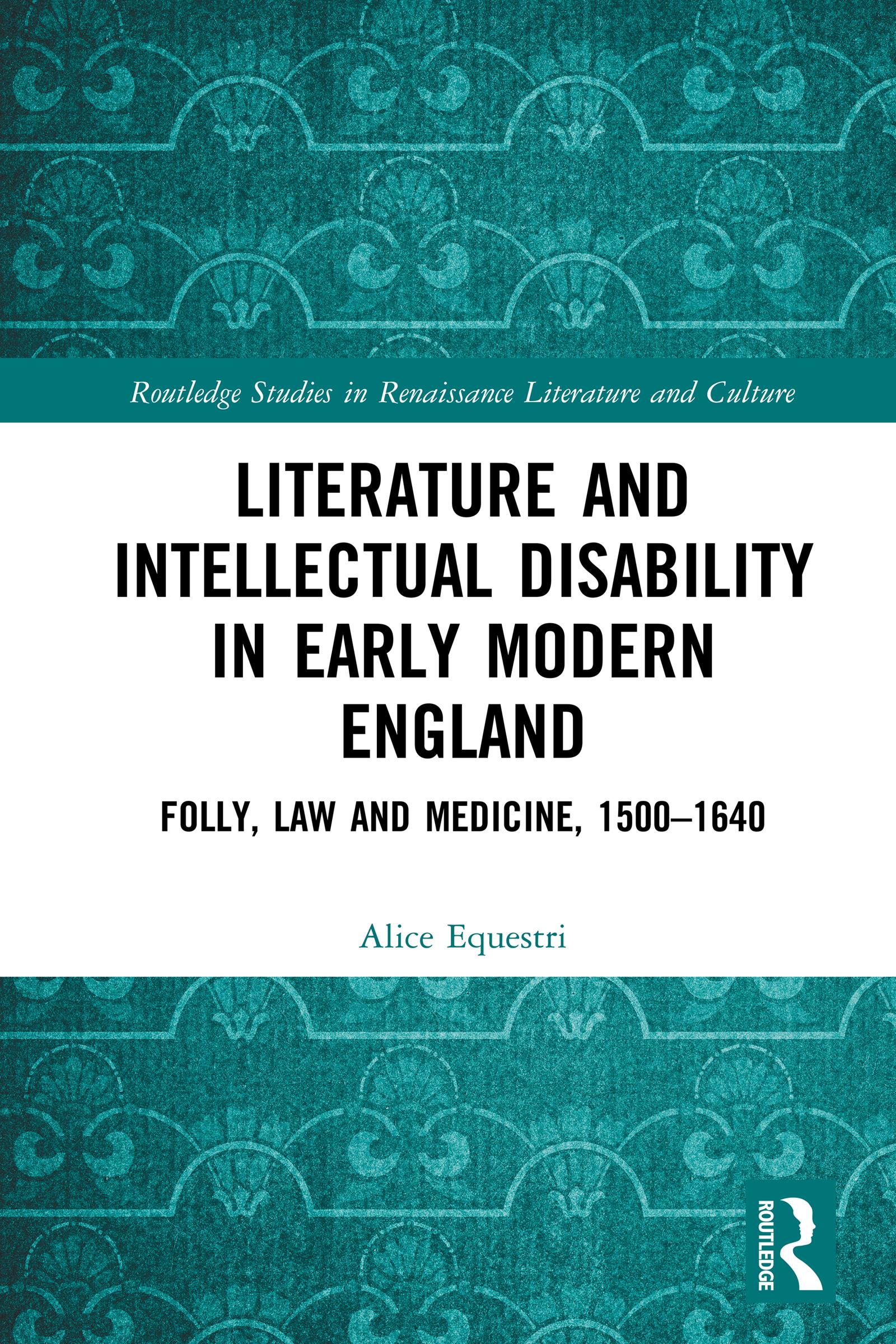
Fools and clowns were widely popular characters employed in early modern drama, prose texts and poems mainly as laughter makers, or also as ludicrous metaphorical embodiments of human failures. Literature and Intellectual Disability in Early Modern England: Folly, Law and Medicine, 1500–1640 pays full attention to the intellectual difference of fools, rather than just their performativity: what does their total, partial, or even pretended ‘irrationality’ entail in terms of non-standard psychology or behaviour, and others’ perception of them? Is it possible to offer a close contextualised examination of the meaning of folly in literature as a disability? And how did real people having intellectual disabilities in the Renaissance period influence the representation and subjectivity of literary fools?
Alice Equestri answers these and other questions by investigating the wide range of significant connections between the characters and Renaissance legal and medical knowledge as presented in legal records, dictionaries, handbooks, and texts of medicine, natural philosophy, and physiognomy. Furthermore, by bringing early modern folly in closer dialogue with the burgeoning fields of disability studies and disability theory, this study considers multiple sides of the argument in the historical disability experience: intellectual disability as a variation in the person and as a difference which both society and the individual construct or respond to. Early modern literary fools’ characterisation then emerges as stemming from either a realistic or also from a symbolical or rhetorical representation of intellectual disability.
Pay easily by card, Klarna, Apple Pay or Google Pay. Not happy? You always have a 14-day money-back guarantee. Read more in our terms. If you have any questions, email us at hello@memmo.org.
Memmo makes studying easier – wherever you are in the world. We bring your course books and smart study tools together in one place: summaries, quizzes, podcasts and flashcards. Plus Ted, your study buddy who answers anything you wonder. Over 50,000 students already study here – built to help you learn faster and stress less.