
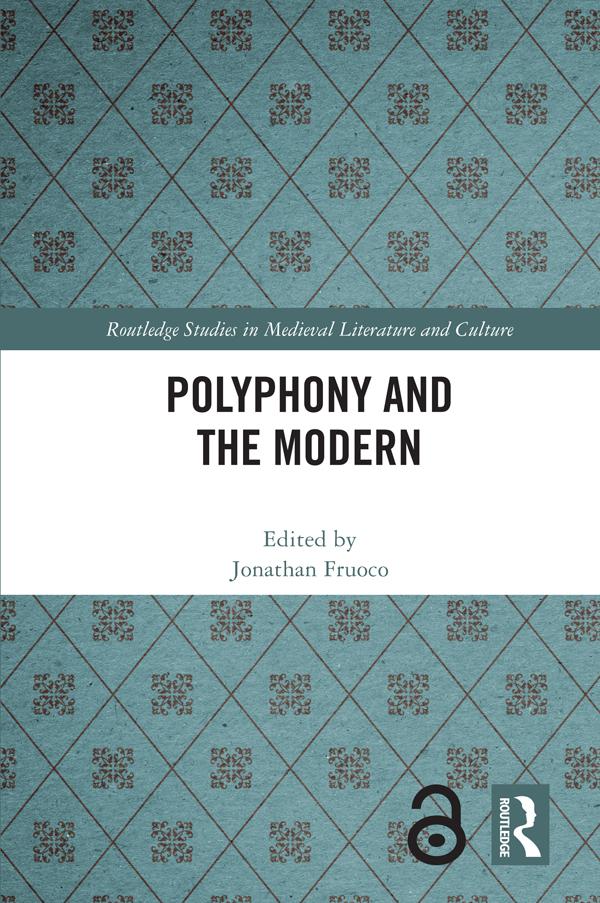
Polyphony and the Modern asks one fundamental question: what does it mean to be modern in one’s own time? To answer that question, this volume focuses on polyphony as an index of modernity.
In The Principle of Hope, Ernst Bloch showed that each moment in time is potentially fractured: people living in the same country can effectively live in different centuries – some making their alliances with the past and others betting on the future – but all of them, at least technically, enclosed in the temporal moment. But can a claim of modernity also mean something more ambitious? Can an artist, by accident or design, escape the limits of his or her own time, and somehow precociously embody the outlook of a subsequent age?
This book sees polyphony as a bridge providing a terminology and a stylistic practice by which the period barrier between Medieval and Early Modern can be breached.
Chapter 1 of this book is freely available as a downloadable Open Access PDF under a Creative Commons Attribution-Non Commercial-No Derivatives 4.0 license available at https://www.taylorfrancis.com/books/edit/10.4324/9781003129837
Pay easily by card, Klarna, Apple Pay or Google Pay. Not happy? You always have a 14-day money-back guarantee. Read more in our terms. If you have any questions, email us at hello@memmo.org.
Memmo makes studying easier – wherever you are in the world. We bring your course books and smart study tools together in one place: summaries, quizzes, podcasts and flashcards. Plus Ted, your study buddy who answers anything you wonder. Over 50,000 students already study here – built to help you learn faster and stress less.